How to Ship a Car from USA to Guatemala: Puerto Quetzal Export Guide
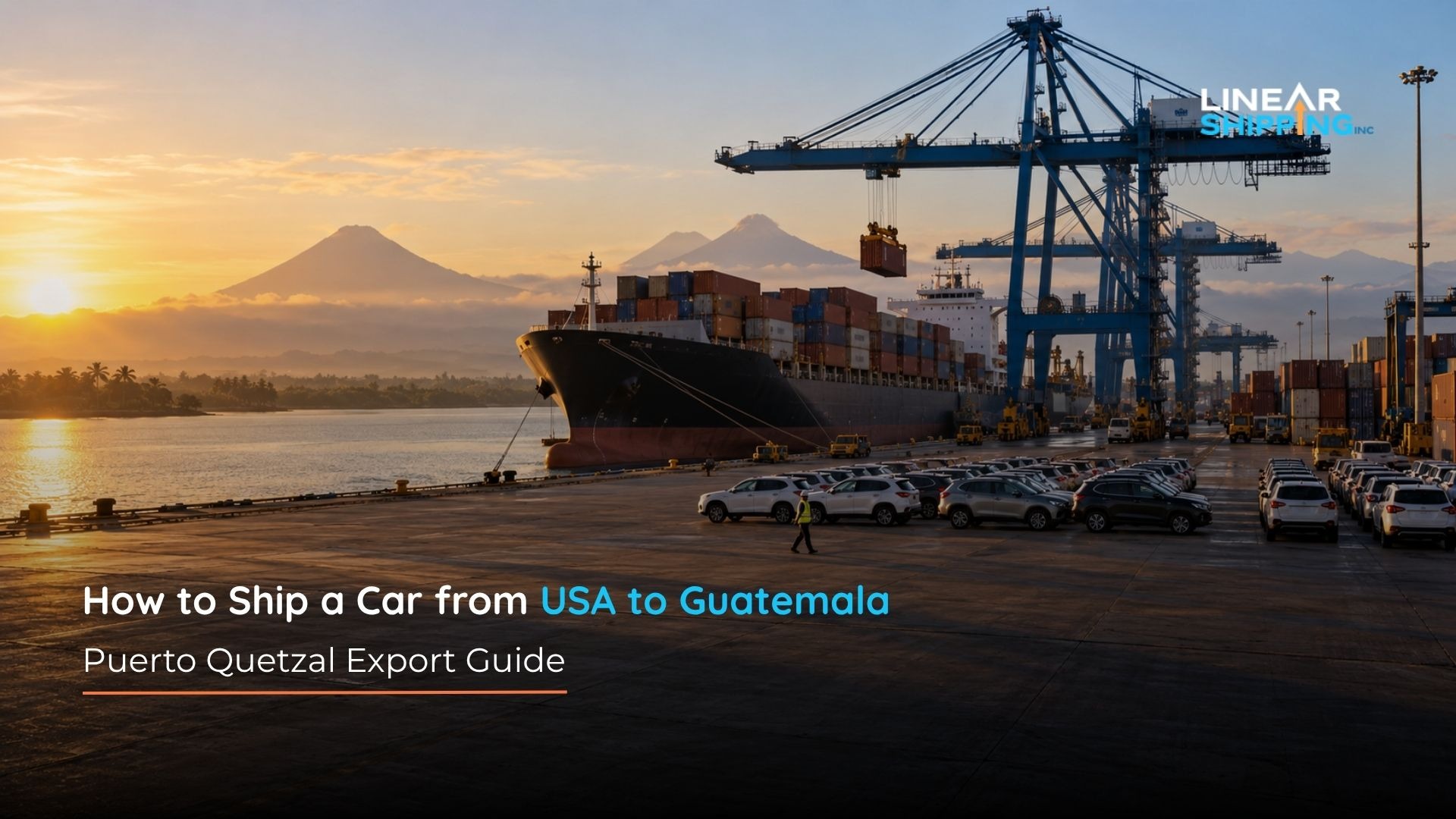
To ship a car from the USA to Guatemala, book container ocean freight from a US Gulf or East Coast port to Puerto Quetzal, the Pacific gateway that receives most vehicle imports, or to Santo Tomas de Castilla on the Caribbean side. File the US export declaration first, and clear the car through a Guatemalan customs broker. Transit runs about 1 to 3 weeks. Passenger cars pay no import duty, but a 12 percent IVA and a 20 percent first-registration tax, IPRIMA, apply on the value SAT assigns.
Guatemala is the largest market in Central America and one of the most active vehicle-import destinations in the region, drawing a steady flow of cars, SUVs and pickups bought in the United States. For dealers and families alike, the appeal is the combination of US selection and pricing with a short ocean lane and, importantly, a customs regime that is more forgiving on vehicle age than its neighbors. Getting the port, the method and the tax picture right is what turns that opportunity into a clean import.
This guide covers the USA to Guatemala lane end to end: which port actually receives the cars and why, the method that dominates this route, how Guatemalan duties and the IPRIMA tax are really calculated, how vehicle age is treated, the documentation and consignee requirements, the transit advantage of a short lane, and how dealers double up on a single container. It completes the picture across the broader Central America vehicle corridor.
Puerto Quetzal as the primary vehicle import gateway
Most cars imported into Guatemala arrive at Puerto Quetzal, the country's principal Pacific port in Escuintla. The reason is geography: Puerto Quetzal sits about two hours from Guatemala City, where the bulk of buyers live and where most customs processing happens, so it is the natural landing point for the vehicle trade. Industry estimates put the large majority of vehicle imports through this single port.
One detail shapes the whole lane. Puerto Quetzal is equipped for container, LoLo and flat-rack cargo but is not set up to receive roll-on roll-off vessels, so vehicles arriving here come in containers. It also tends to clear container vehicles a couple of business days faster than the Caribbean alternative, which for a first-time importer usually means fewer storage-day surprises. For a car bound for Guatemala City and the central highlands, Puerto Quetzal is almost always the right gateway.
Santo Tomas de Castilla as the Atlantic-side alternative
On the opposite coast, Santo Tomas de Castilla is Guatemala's largest Caribbean seaport, in Izabal, and it serves as the Atlantic-side alternative. Unlike Puerto Quetzal, it is equipped to handle roll-on roll-off as well as container, LoLo and flat-rack cargo, so it carries more of the East Coast RoRo traffic, alongside the nearby port of Puerto Barrios.
Santo Tomas makes sense when the vehicle is coming from the US East Coast or Gulf and the final destination is in eastern Guatemala, since it is the most direct arrival point from the Caribbean side and avoids the Panama Canal routing. The trade-off is a busier queue and slightly slower container clearance than Puerto Quetzal, so the choice between the two comes down to the inland destination and the shipping line's service, which should be settled before the ocean booking is made.
Why container is the dominant method on this lane
Container shipping is the dominant method for the USA to Guatemala lane, and Puerto Quetzal's container-only setup is a big part of the reason, since the port that receives most vehicles does not take RoRo at all. Beyond that, container simply fits how the trade works. A sealed box protects the vehicle across the ocean leg, it accepts non-running and salvage-title cars that cannot drive aboard a RoRo vessel, and it allows approved personal items to travel inside the car, which RoRo does not permit.
The other advantage is economics at scale. A 40-foot container can carry two vehicles, so cost can be shared across a pair, which matters for dealers and is covered further below. As on the Honduras lane, container is the standard that keeps a Central America shipment flexible across running, non-running and multi-vehicle loads.
Guatemalan customs duties and taxes on used vehicles
Guatemala's vehicle tax structure is widely misreported, so it is worth stating precisely. Many shipping guides quote a 20 percent import duty, but for passenger cars the import duty, or DAI, is actually 0 percent. The taxes that do apply are two.
- IVA (value-added tax) at 12 percent, charged at the customs office of entry.
- IPRIMA, the specific tax on first registration, at 20 percent for a vehicle carrying up to five people including the driver. Crucially, IVA and IPRIMA do not cascade, so neither is charged on top of the other, giving a combined vehicle tax of around 32 percent.
The base those taxes apply to is the key nuance. Guatemala's tax authority, SAT, assesses vehicles against its own annual valuation tables rather than the price paid, so a car bought cheaply can still be taxed on a higher official value. Electric vehicles are IVA-exempt under a 2022 decree, and a separate circulation tax, the ISCV, is prorated on first registration. Because the valuation tables and rates are updated each year, the landed tax on a specific car should be estimated with a Guatemalan customs broker before purchase, using the current SAT tables.
Check the SAT value before you buy. Since IVA and IPRIMA are calculated on SAT's assigned value, not your invoice, a low purchase price does not guarantee a low tax bill. Confirming the table value for the exact make, model and year in advance is the simplest way to avoid a surprise at clearance.
Vehicle age restrictions and compliance requirements
Here Guatemala stands apart from its neighbors in a way that favors importers. Where El Salvador and Honduras enforce firm maximum-age limits on used vehicles, Guatemala does not apply a hard age ban in the same way. Older used vehicles can be imported, and the first-registration tax simply scales with age: newer cars pay the full 20 percent IPRIMA, while much older vehicles fall into brackets that pay a low fixed amount instead, on the order of a few hundred to about a thousand quetzals for vehicles beyond roughly 10 to 15 years.
That leniency widens what a buyer can source, but a few rules still apply. Left-hand-drive vehicles are standard and accepted, salvage titles are permitted provided they are disclosed and declared, and the vehicle must clear the SAT valuation and customs process cleanly. Because some import guides still claim a strict 10-year limit and official rules can change, the current age position should be confirmed with a Guatemalan customs broker before committing to a purchase.
Documentation package and consignee requirements
Guatemala clears imported vehicles through a licensed customs broker, and the paperwork has to be complete and consistent for the entry to go smoothly. A shipment generally needs the following.
- Original vehicle title, the original document and not a copy, clear of any lien, since a financed car needs the loan paid off and a clean title first.
- Bill of sale or purchase invoice, used to declare the value, though SAT may apply its own table value.
- US export declaration, filed before the vessel sails.
- Guatemalan customs broker, an agente aduanero, which is mandatory to file the customs declaration.
- Consignee identification, including the importer's NIT tax number and SAT registration for the entry and later plating.
The single most common failure point is the title, so an original, lien-free title that matches the export filing and the bill of lading exactly is worth confirming before anything ships. Because the exporter remains responsible for the accuracy of the US export data, the filing and the vehicle details need to line up from the US side through to the Guatemalan broker.
Transit times from Houston and Gulf ports
One of the real strengths of this lane is speed. Guatemala is close, so ocean transit from US Gulf and East Coast ports generally runs about 1 to 3 weeks, which makes it one of the shorter international car lanes from the United States. The Caribbean port of Santo Tomas de Castilla is the most direct run from the Gulf, reachable in around a week, while Puerto Quetzal on the Pacific is reached through the Panama Canal and runs a little longer, though it remains the primary destination because of its proximity to Guatemala City.
For a Houston shipper the short-lane advantage is significant, because a car sourced across Texas and the South can be staged near the Gulf and on the water quickly, with far less ocean time than a transoceanic route. Set against the multi-week transshipment of a long lane such as shipping a car to the Middle East, the Central America run is short and predictable, which keeps schedules tight and storage exposure low.
Dealer consolidation: two vehicles per 40ft container
For dealers moving volume, the container economics are what make the lane work. A single 40-foot container can hold two vehicles, so the cost of the box is shared across a pair, which lowers the per-car shipping cost compared with sending each vehicle on its own. Shared and exclusive loading options both exist, so a dealer can pair two of their own cars, and a family can consolidate a vehicle with household goods in the same box.
This pairing is a routine part of a well-run Guatemala program, and it is one reason container beats other methods for repeat importers. Coordinating the pickup, the pairing and the loading through one operator is what keeps a two-car container moving cleanly, and a Houston freight forwarding company positioned at a Gulf gateway can stage and pair vehicles close to the water to keep the domestic leg short.
Frequently asked questions
Which port in Guatemala handles imported vehicles?
Puerto Quetzal, on the Pacific coast in Escuintla, handles the large majority of imported vehicles because it sits about two hours from Guatemala City, where most buyers and customs processing are. It receives containers, LoLo and flat rack but not roll-on roll-off. Santo Tomas de Castilla, on the Caribbean coast, is the secondary gateway and the one equipped for RoRo.
How long does it take to ship a car from the USA to Guatemala?
Ocean transit generally runs about 1 to 3 weeks, which makes Guatemala one of the shorter international car lanes from the US. The Caribbean port of Santo Tomas de Castilla is the most direct run from the Gulf and East Coast, while Puerto Quetzal on the Pacific is reached through the Panama Canal, so it runs a little longer but remains the primary destination.
What are Guatemala's vehicle import duties?
For passenger cars the import duty, or DAI, is 0 percent. The vehicle taxes are IVA at 12 percent and the first-registration tax, IPRIMA, at 20 percent for a vehicle carrying up to five people, and the two do not stack on each other. Both are calculated on the value SAT assigns from its annual valuation tables rather than the purchase price, and electric vehicles are IVA-exempt.
Is there a vehicle age limit for imports into Guatemala?
Guatemala does not enforce a strict maximum age the way neighboring El Salvador and Honduras do. Older used vehicles can be imported, and the first-registration tax, IPRIMA, scales with age instead, so older vehicles pay a lower fixed amount rather than being refused. Because guidance varies and rules change, confirm the current position with a Guatemalan customs broker before buying.