How to Ship a Car from USA to El Salvador: Acajutla Port Export Guide
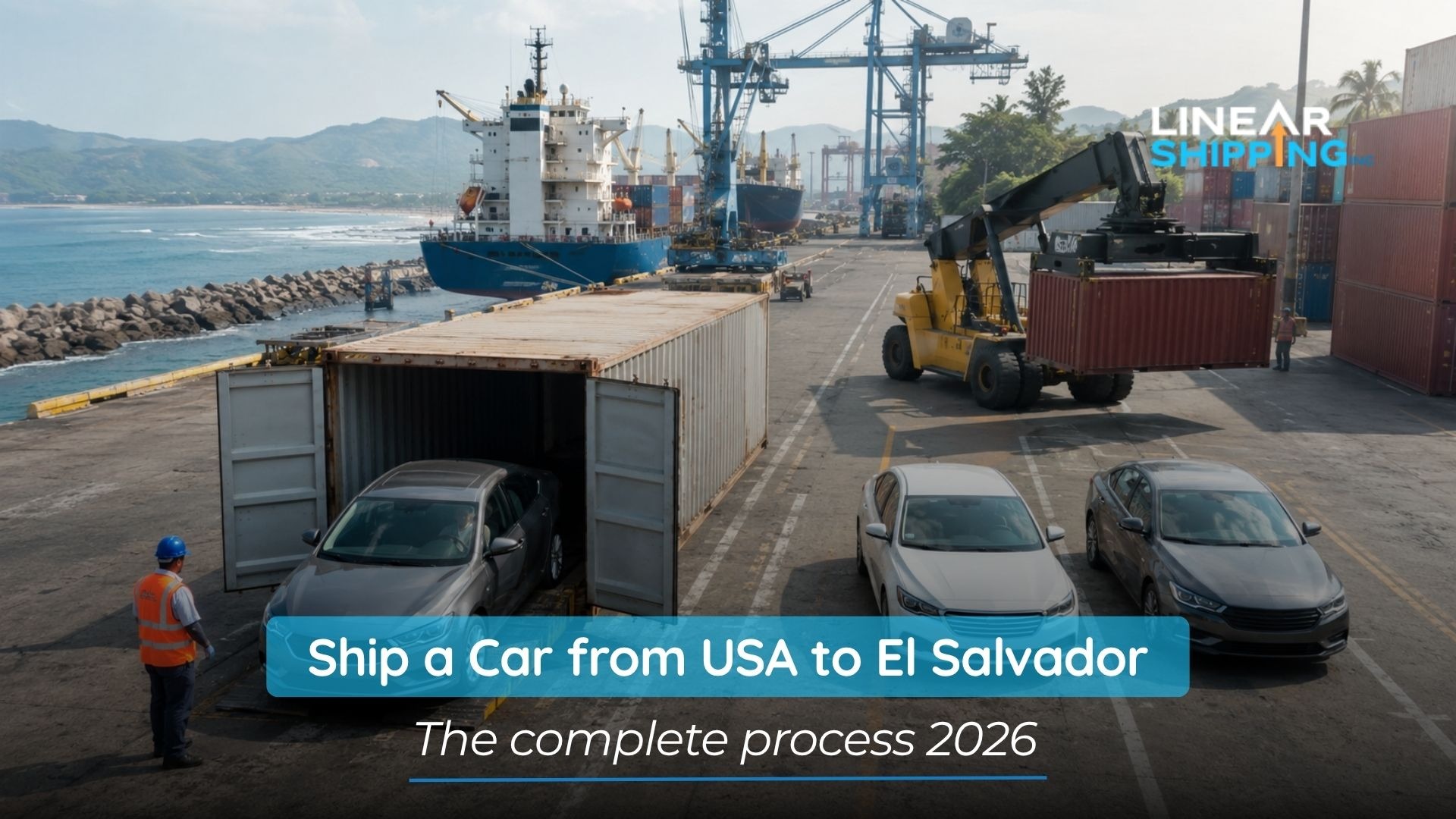
How do I ship a car from the USA to El Salvador (Acajutla)?
To ship a car from the USA to El Salvador, secure the vehicle title, file Electronic Export Information through the Automated Export System, and book container ocean freight to Acajutla, El Salvador's main Pacific vehicle port. Because Acajutla is on the Pacific coast, cargo from US Gulf ports routes through the Panama Canal or transships, and a Salvadoran customs broker clears the car against its CIF value once duties and the 13 percent VAT are paid.
El Salvador is a steady, well-established destination for vehicles bought at US auctions. Salvadoran dealers and importers pull cars from American auction platforms and route them home to a market that runs on the US dollar, sits under the CAFTA-DR trade agreement, and treats American vehicles as everyday cargo. The lane rewards preparation, because El Salvador applies firm rules on vehicle age and leans on a Pacific-coast port that most auction cars reach by container rather than by a straight Caribbean sailing.
This guide covers the El Salvador lane end to end for commercial buyers: the port that handles the cars, how vehicles physically reach a Pacific port from the US Gulf, why container is the practical method, how dealers consolidate to cut cost, the customs duties and the trade-agreement angle that can lower them, the age rules that decide eligibility, and the documents that keep a shipment clearing cleanly. Treat the duty rates and age cutoff as figures to confirm with a Salvadoran customs broker before you bid.
Why El Salvador is an accessible lane for US auction buyers
Two features make this lane unusually smooth on paper. First, El Salvador uses the US dollar as its official currency, so CIF values, duty calculations and payments are all handled in dollars, which removes the exchange-rate friction that complicates many import markets. Second, El Salvador is a member of CAFTA-DR, the free trade agreement between the United States and Central America, which opens the door to reduced or eliminated import duty on qualifying US-origin vehicles when the paperwork is done correctly.
On top of that, the United States is a primary trading partner, and used vehicles are a familiar import category, so carriers, customs systems and brokers on this lane handle American cars as routine. A Salvadoran dealer buying from US auctions is working with an established flow, and the same disciplined process that moves vehicles across Central America as a region applies directly to the El Salvador run.
Acajutla: El Salvador's main vehicle import port
Acajutla is the center of this lane. It is El Salvador's principal seaport, located on the Pacific coast in the Department of Sonsonate, roughly 85 kilometers from the capital, San Salvador, and operated by the national port authority CEPA. The port runs three quays with eight berths and is built as a multipurpose facility, receiving container vessels, bulk carriers, tankers and car carriers, which means it is equipped to take vehicle cargo alongside the grain and commodity traffic that has long been its backbone.
Acajutla is also modernizing. A major investment led by the terminal operator Yilport, in partnership with CEPA, is set to expand and upgrade the port with projected capacity increases, which points to more frequent container service and smoother handling over time. For a vehicle importer, Acajutla offers the container frequency, customs infrastructure and inland road links to San Salvador that make it the default arrival point.
La Union as a secondary option
Puerto La Union Centroamericana, on the Gulf of Fonseca in eastern El Salvador, is the secondary gateway. It is a modern deep-water port designed for large Post-Panamax vessels and is included in the same national modernization push, though it has historically been underused relative to its capacity. For most vehicle importers, Acajutla remains the practical choice because of its established service and proximity to the main population centers, but La Union is a useful alternative for consignees in the eastern part of the country.
Why container shipping is the primary method to El Salvador
Acajutla can handle roll-on roll-off, but on the US-to-El Salvador lane container shipping is the practical primary method. Dedicated RoRo sailings from the United States to Pacific-side El Salvador are limited and less frequent than container service, so containerized transport offers more sailings, more predictable timing and better protection for the vehicle on a longer routing.
Container shipping brings clear advantages for auction cars. The vehicle travels fully enclosed and secured inside a 20-foot or 40-foot box, which shields it from weather and handling on a route that often involves transshipment, and it allows non-running units to ship at all, since they never need to drive aboard. Choosing between the two methods is a standard step, and the broader logic of international auto shipping tilts toward container for El Salvador given the service pattern and the port's strengths. The detail behind weighing RoRo against container reinforces that choice on this particular lane.
Dealer consolidation: two vehicles in one 40-foot container
Consolidation is the biggest cost lever for dealers. A standard 40-foot container holds two vehicles loaded and braced safely, which splits the ocean cost across two units and is why high-volume importers rarely ship a single car alone. Sedans and compact SUVs pair well in a 40-foot box, so a dealer running steady volume can keep paired units moving continuously on the lane, while larger trucks or tall SUVs take more room and may ship one to a box. Matching vehicle size to container capacity before booking is what keeps the per-unit cost down on a route where the ocean leg is longer than a direct Caribbean run.
How cars reach Acajutla from the US Gulf and how long it takes
This is the part that surprises first-time importers. Acajutla sits on the Pacific coast, while the US Gulf and East Coast face the Atlantic and Caribbean, so a car does not sail in a straight line to El Salvador. Instead, cargo typically routes one of two ways: through the Panama Canal to reach the Pacific side directly, or by transshipment through a hub port before the final leg into Acajutla. Both are routine, but both add time compared with a direct Caribbean lane.
On a full door-to-port basis, which includes collecting the car from the auction yard, moving it to the export port, consolidating and sailing, most shipments from Houston and other US Gulf ports to Acajutla land in roughly 14 to 25 days. The range is wider than shorter Caribbean lanes precisely because of the Pacific routing and any Canal transit or transshipment along the way, and vessel schedules and consolidation timing move a shipment within that window.
A transshipment note for CAFTA-DR. When a shipment transships through another country, especially Panama, on its way to El Salvador, Salvadoran customs expects documentation showing the transit took place under customs control in order to preserve CAFTA-DR treatment. Getting this right protects the duty benefit on a qualifying vehicle, so the routing and the origin paperwork need to line up.
El Salvador customs duties and import regulations
El Salvador assesses vehicle import charges on the CIF value, the cost, insurance and freight figure. The charges then compound, since the value added tax is applied on top of the duty rather than on the vehicle value alone. The general structure looks like this, though exact rates vary by classification, engine size and customs assessment, so confirm the live figures with a licensed Salvadoran customs broker before importing.
| Charge | What it is | Basis |
|---|---|---|
| Import duty (DAI) | The customs duty on motor vehicles, generally assessed in the range of about 25 to 30 percent, though qualifying US-origin vehicles may see it reduced or eliminated under CAFTA-DR | CIF value |
| VAT (IVA) | The value added tax charged on all imports at 13 percent | CIF value plus duty |
| Customs and port fees | Documentation, processing and terminal handling charges applied at clearance | Varies |
| Environmental charges | Additional charges that may apply depending on the vehicle | Varies |
The CAFTA-DR angle for US vehicles
The trade agreement is the lever most auction buyers underuse. Under CAFTA-DR, vehicles that qualify under the rules of origin can receive reduced or eliminated import duty, provided a certificate of origin issued in the United States accompanies the shipment and the importer claims the preference at clearance. The catch is that many auction cars are foreign-branded units, and whether a specific vehicle qualifies depends on where it was actually manufactured and whether the origin documentation is correct. When a unit does qualify, the saving on the duty line is significant, which is why the certificate of origin is worth confirming before purchase rather than after arrival.
Vehicle age requirements
El Salvador enforces vehicle age limits by category, and an ineligible car can be refused at the port, leaving the importer to absorb storage and return costs. The commonly applied limits, measured from the year of manufacture, are as follows.
- Cars and pickups: generally no older than 8 years. In 2026, that typically means model or build years from around 2018 onward.
- Buses: generally no older than 10 years.
- Trucks and heavier cargo vehicles: generally eligible up to around 15 years.
Because the limit is applied by vehicle classification and has been adjusted over time, the build year on the VIN plate should be checked against the current rule before bidding. Salvage and rebuilt vehicles face additional scrutiny, and a junk-titled unit can be blocked from export on the US side and from import on the Salvadoran side, so a salvage auction find needs to be verified against both sets of rules rather than assumed eligible.
Age is not the only condition test. El Salvador applies emissions and safety standards, and imported vehicles undergo a technical inspection before they can be registered and legally driven, with registration and plates issued only after the inspection is passed and all duties and taxes are settled. Factoring the inspection and registration steps into the timeline keeps a dealer from treating port release as the finish line when there is still a compliance step to clear.
Confirm eligibility before the hammer falls. Age and title status are pass or fail at the port, and El Salvador does not allow on-arrival changes to bring a non-compliant car into line. Checking the manufacture year and the title type before bidding is the single most effective way to avoid a rejected unit and the costs that follow.
Documentation for a US-to-El Salvador car export
A clean clearance depends on a complete, consistent document set that lines up across the US export side and the Salvadoran import side. A typical vehicle shipment needs the following.
- Original vehicle title. Clear of liens, or accompanied by a notarized lien release, this proves ownership for both US export and Salvadoran clearance.
- AES filing and ITN. US rules require Electronic Export Information for vehicle exports, and the resulting Internal Transaction Number is the proof the carrier needs before loading.
- Bill of lading. The carrier's contract and title document for the ocean leg.
- Commercial invoice or bill of sale. Showing the VIN, make, model, year and value, which feeds the CIF customs valuation.
- Certificate of origin. Issued in the United States, required to claim CAFTA-DR treatment on a qualifying vehicle.
- Consignee NIT and power of attorney. The importer's Salvadoran tax identification, plus authorization for the customs broker to clear on their behalf.
On the US side, vehicle exports carry their own filing discipline, and getting the AES filing right is non-negotiable, because the exporter stays responsible for the accuracy of the data even when a forwarder submits it on their behalf. A mismatch between the title, the invoice and the bill of lading is exactly the kind of discrepancy that stalls a clearance, so consistency across the set matters as much as having every document present.
How Linear Shipping serves the El Salvador lane from Houston
Running this lane well comes down to sequencing near the water and controlling a longer routing. Cars won at US auctions are collected and staged near the Houston terminals, paired into 40-foot containers where possible to keep the per-unit cost down, and booked onto services that route to Acajutla by Canal transit or transshipment. The export filing and document set are prepared in parallel so the ITN and paperwork are ready before the vessel cutoff, and the shipment is tracked from terminal to arrival so a Salvadoran customs broker can clear it without the car sitting in storage.
Because Houston is a top US export gateway with dense carrier coverage, staging the shipment there keeps the domestic leg short and the routing options open, which matters more on a Pacific-side destination than on a direct Caribbean run. Mapping the right routing for a specific vehicle starts with a short conversation about the unit, its build year and the destination, and you can begin that conversation about your shipment as soon as the car is ready to move.
Frequently asked questions
Can I ship a car from USA to El Salvador?
Yes. El Salvador is an active import market for US vehicles, and cars are shipped regularly from US ports to Acajutla by container. The vehicle must meet El Salvador's age and condition rules, and a licensed Salvadoran customs broker clears it against its CIF value once the import duty and the 13 percent VAT are paid.
Which port in El Salvador handles car imports?
Acajutla, on the Pacific coast in the Department of Sonsonate, is the main vehicle import port. It is El Salvador's principal seaport, operated by the national port authority CEPA, and handles container and vehicle cargo about 85 kilometers from San Salvador. Puerto La Union, on the Gulf of Fonseca, is a modern deep-water alternative for eastern El Salvador.
How long does it take to ship a car from USA to El Salvador?
Because Acajutla is a Pacific port, cargo from US Gulf ports routes through the Panama Canal or transships, so the full door-to-port timeline, including auction pickup, consolidation and sailing, commonly lands in roughly 14 to 25 days. The range is wider than a direct Caribbean lane because of the routing and any Canal transit or transshipment.
What are the import duties on cars in El Salvador?
Motor vehicles are generally assessed an import duty in the range of about 25 to 30 percent of the CIF value, plus a 13 percent VAT calculated on the CIF value plus duty. Qualifying US-origin vehicles may see the duty reduced or eliminated under CAFTA-DR with a valid certificate of origin, so rates should be confirmed with a licensed Salvadoran customs broker.
Is container or RoRo better for El Salvador?
Container is the primary and more practical method on this lane, because dedicated RoRo service from the United States to Pacific-side El Salvador is limited while container sailings are more frequent and better suited to the longer routing. Container also protects the vehicle in transit and allows two cars to be consolidated in one 40-foot box.