RoRo vs Container Shipping: Which Is Better for Car Exports?
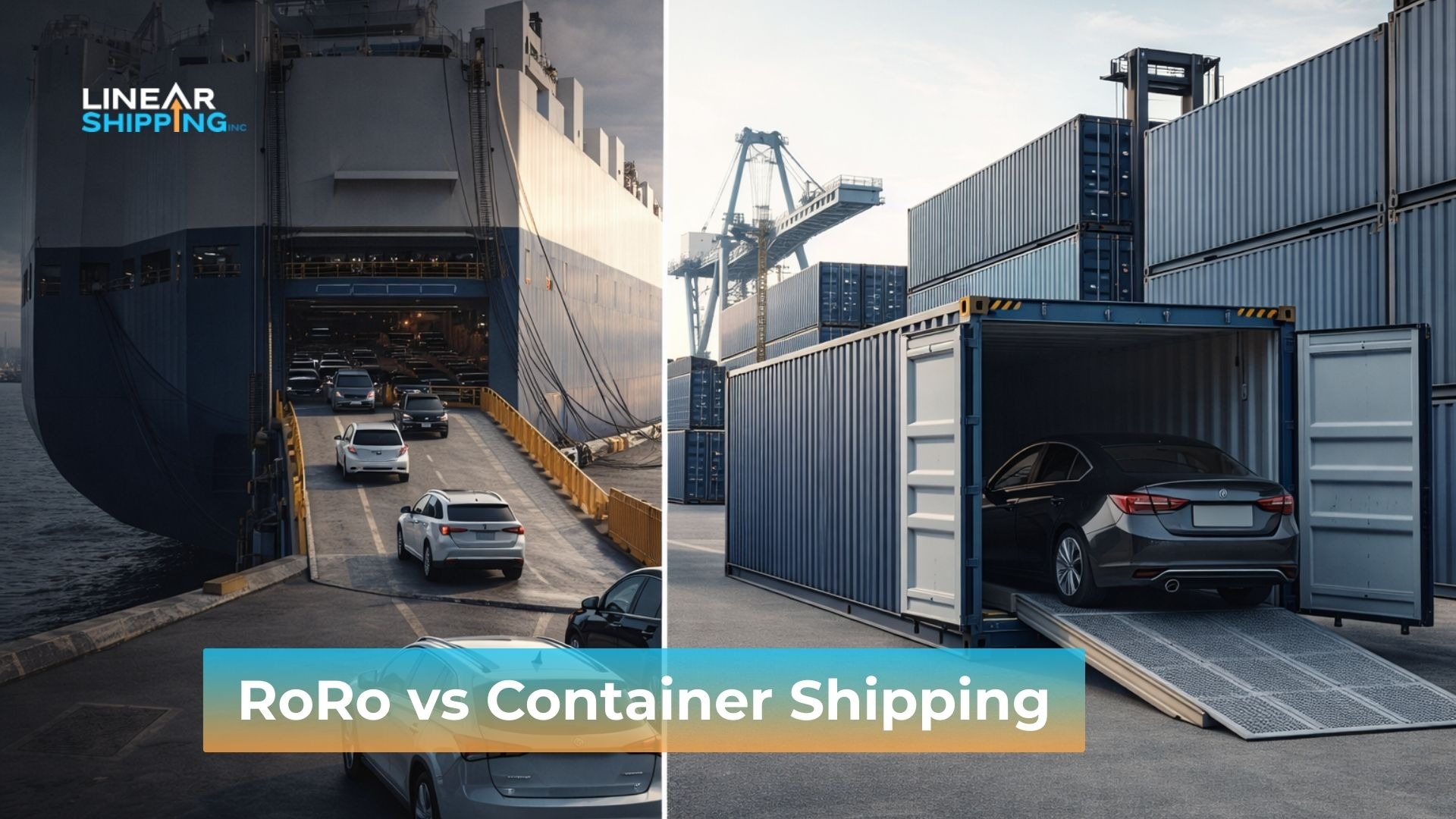
RoRo (Roll-on/Roll-off) is the most cost-efficient method for exporting running vehicles from the United States, offering lower rates and faster port processing on established auto trade lanes. Container shipping provides greater protection and flexibility, making it the better choice for high-value, non-running, or salvage vehicles. The right method for your shipment depends on vehicle condition, destination port, cargo value, and whether you need to include spare parts or personal effects with the car.
Every vehicle exporter shipping cars from the United States faces the same fundamental question at the start of every shipment: RoRo or container?
It sounds like a simple choice. In practice, it is one of the most commercially consequential decisions in the vehicle export process. Choose the wrong method and you either overpay significantly, expose a high-value vehicle to unnecessary risk, miss a sailing because the destination port does not support the method you booked, or create documentation problems that slow customs clearance on the receiving end.
This guide explains both methods in precise, practical terms. It covers when each method wins, what it actually costs, how destination ports affect your options, and how to make the decision correctly for every shipment type. Whether you are an auction buyer shipping a single car to Dubai, a dealer consolidating vehicles for Lagos, or a logistics company managing regular exports to Central America, this breakdown applies directly to your operation.
What Is RoRo Shipping?
RoRo stands for Roll-on/Roll-off. It describes a class of ocean vessels designed specifically for wheeled cargo. Instead of cranes or container handling equipment, vehicles are driven or towed directly onto the ship through a stern or side ramp and secured on the vessel's internal decks.
The image is accurate: a RoRo vessel operates like a floating multi-level parking garage. Vehicles are loaded under their own power when running, or by specialized tow equipment and forklifts when non-running. Once on board, they are secured with wheel chocks and lashing straps according to the carrier's lashing manual.
RoRo vessels run fixed schedules on dedicated automotive trade lanes. Major routes from U.S. ports include departures from Baltimore, Houston, Savannah, Los Angeles, and New York to destinations across the Middle East, West Africa, Central America, Europe, and Asia. These are not general cargo vessels repurposed for vehicles. They are purpose-built PCTC (Pure Car and Truck Carrier) vessels maintained by carriers such as Wallenius Wilhelmsen, Grimaldi, EUKOR, and K-Line.
What Types of Cargo Travel on RoRo?
RoRo is built for any wheeled or tracked cargo that can be rolled, driven, or towed. This includes:
- Passenger cars and SUVs (new and used)
- Pickup trucks and vans
- Buses and coaches
- Commercial trucks and trailers
- Construction equipment: excavators, bulldozers, loaders, graders
- Agricultural machinery: tractors, harvesters, combines
- Military vehicles and generators on wheels or tracks
For vehicle exporters working with auction cars from Copart, IAAI, or Manheim, RoRo is the default consideration for any car that runs or can be easily towed.
What Is Container Shipping for Cars?
Container shipping for vehicles places the car inside a standard ISO shipping container, typically a 20-foot or 40-foot steel box, which is then loaded onto a container vessel using port cranes and handled through a traditional container terminal.
The vehicle is driven or forklift-loaded into the container at a stuffing facility, secured with wheel chocks and lashing straps, and the container is sealed before leaving for the port. At the destination, the container is unstuffed either at the port or at an inland depot before the vehicle is released to the consignee.
For vehicles, container shipping is most commonly used in two configurations:
- Exclusive Container Load: One vehicle, or multiple vehicles stacked in a 40-foot container, filling the entire box. This provides maximum security and is the typical choice for luxury, classic, or high-value vehicles.
- Consolidated Container: Multiple vehicles from different shippers or dealers sharing a 40-foot container. This is sometimes called shared container or consolidated vehicle shipping. It significantly reduces the per-vehicle cost compared to an exclusive box, and in many cases makes container shipping price-competitive with RoRo for standard vehicles.
Understanding how consolidated container shipping works helps illustrate why consolidation can make container shipping a viable cost alternative even for budget-conscious exporters.
RoRo vs Container Shipping: Side-by-Side Comparison
| Factor | RoRo | Container |
|---|---|---|
| Cost for running vehicles | Lower | Higher (exclusive), competitive (consolidated) |
| Vehicle protection | Exposed to sea air, vessel environment | Fully enclosed, protected from elements |
| Non-running vehicles | Possible with forklift, surcharge applies | Standard, no surcharge |
| Destination port flexibility | Limited to RoRo terminals | Available at nearly all major container ports |
| Spare parts with vehicle | Not permitted | Permitted inside container |
| Personal effects in vehicle | Not permitted | Sometimes permitted (check destination rules) |
| Sailing frequency | Weekly on major lanes | Multiple per week on most lanes |
| Loading time at port | Faster | Slightly longer due to stuffing and crane handling |
| Luxury or high-value vehicles | Higher exposure risk | Better protection |
| Salvage or severely damaged vehicles | Requires forklift, may not be accepted | No additional requirement |
| Typical transit: USA to Dubai | 21 to 35 days | 21 to 35 days (similar on main lanes) |
The comparison table makes the trade-offs visible but it does not make the decision. The decision requires knowing the specifics of your shipment.
When RoRo Is the Better Choice
RoRo wins on cost efficiency for running vehicles going to major RoRo-served ports. These are the situations where RoRo consistently outperforms container shipping.
Your Vehicle Runs and Drives
This is the most basic qualifier. If a car can be driven onto the vessel, RoRo is almost always cheaper. The absence of container hire, stuffing labor, forklift handling, and drayage to a stuffing facility means the per-vehicle rate is structurally lower.
You Are Shipping to a Major Automotive Port
RoRo is only available at terminals with dedicated RoRo infrastructure. Major RoRo-served destinations from the U.S. include Jebel Ali (Dubai), Aqaba (Jordan), Basra (Iraq), Tema (Ghana), Lagos/Apapa (Nigeria), Cotonou (Benin), Acajutla (El Salvador), Puerto Cortes (Honduras), and Puerto Quetzal (Guatemala). If your destination is on this list, RoRo is generally available and cost-competitive.
For exporters shipping auction cars to the Middle East, RoRo from Houston or Baltimore to Jebel Ali is one of the most actively used lanes in the U.S. auto export market. The USA to Middle East car shipping guide covers port-specific procedures, transit windows, and documentation requirements for this lane in detail.
You Are Shipping Standard Passenger Cars or SUVs
For a standard Copart or IAAI purchase with a clean or salvage title, running condition, and no extreme dimensions, RoRo will typically be the lower-cost option by 15 to 30 percent compared to an exclusive container. The savings are real and meaningful at scale, especially for dealers moving multiple units per month.
You Need Predictable Sailing Schedules
On major automotive routes, RoRo carriers operate fixed weekly or bi-weekly sailings. This predictability is valuable when you are coordinating against auction pickup windows and need to commit to a vessel cutoff date. The various factors that affect international car shipping costs include inland storage fees that accumulate when vehicles miss vessel cutoffs, which is why schedule reliability matters operationally and financially.
You Are Moving Operational Heavy Equipment
For tracked or wheeled heavy machinery that is operational, RoRo via flat rack or direct deck loading is often more cost-effective than container. Excavators, wheel loaders, and bulldozers that run under their own power can be driven onto RoRo vessels without the crane equipment and specialized rigging that a flat rack container arrangement requires. Linear Shipping handles both RoRo and flat rack options through its heavy equipment shipping service, with the method selected based on machine dimensions and destination port capability.
When Container Shipping Is the Better Choice
Container shipping wins whenever protection, flexibility, or destination accessibility outweighs the cost savings from RoRo. These are the conditions where container is the correct choice.
Your Vehicle Is Non-Running or Salvage
A non-running vehicle can technically move via RoRo on many lanes, but it requires forklift handling and typically incurs a non-runner surcharge. Not all RoRo terminals have the equipment or procedures to handle severely damaged or inoperable vehicles safely. Container shipping eliminates this uncertainty. The vehicle is loaded by forklift at a controlled stuffing facility with no special terminal handling requirement.
For dealers regularly buying non-runners from Copart or IAAI, container shipping is the operationally cleaner choice. There are no forklift surcharges at the stuffing stage since the fee is factored into the container quote. There are no port-level surprises about whether the terminal can handle a specific vehicle condition.
Your Vehicle Is High-Value, Luxury, or a Classic
A vehicle worth $40,000 or more deserves to travel in an enclosed, sealed container. RoRo vessels expose vehicles to salt air, temperature fluctuation, condensation, and the physical environment of a vessel deck. These conditions can cause corrosion, interior deterioration, and minor cosmetic damage that is acceptable on a $5,000 salvage car but is not acceptable on a luxury SUV or a restored classic.
Container shipping keeps the vehicle completely enclosed from the stuffing facility to the destination port. For vehicles where condition on arrival directly affects resale value, container shipping is the correct choice regardless of the cost differential.
You Need to Include Spare Parts or Accessories
RoRo carriers strictly prohibit loose items inside vehicles. No spare tires, no replacement parts, no personal effects. Container shipping allows exporters to include spare parts, service manuals, accessories, and in some destination markets, a limited quantity of personal effects, all packed alongside the vehicle inside the same container.
This matters for Middle Eastern buyers who often want the spare tire, service history, and floor mats shipped with the vehicle. It also matters for dealers who want to include parts inventory alongside a vehicle export to reduce overall freight costs through consolidated shipments.
Your Destination Port Does Not Support RoRo
Hundreds of ports worldwide do not have RoRo terminal infrastructure. If your buyer is located in a secondary market or an inland city served by a port without RoRo capability, container is the only option. This is common in parts of West Africa, Southeast Asia, and secondary Middle Eastern markets.
For exporters shipping to Nigeria specifically, while Lagos/Apapa handles both RoRo and container traffic, many secondary Nigerian destinations and buyers prefer container shipments for the additional control they provide over customs presentation. The West Africa car shipping guide covers port-specific considerations for Lagos, Tema, and Cotonou in detail.
You Want to Consolidate Two Small Vehicles in One Container
Two compact cars or sedans will often fit in a standard 40-foot container when loaded by a professional stuffing crew. If you are exporting two vehicles to the same destination, splitting the cost of a 40-foot container between both units can make the per-vehicle container rate competitive with or even lower than two individual RoRo bookings, while providing the added protection of a sealed container.
How Your Destination Affects the Method Decision
The destination port is one of the most decisive factors in this choice, and it is one that many first-time exporters overlook until after they have committed to a method.
Middle East
The primary Middle East auto trade lanes from the United States are well-served by both RoRo and container. Jebel Ali (Dubai) and Aqaba (Jordan) are major RoRo hubs with weekly sailings from U.S. Gulf and East Coast ports. Basra (Iraq) also receives RoRo traffic, though vessel schedules are less frequent than Jebel Ali.
For standard running vehicles going to Dubai, RoRo is typically the more common and cost-effective choice. For high-value vehicles or consolidated shipments with parts, container via Jebel Ali works well. The complete guide to exporting cars from the USA to the Middle East provides transit windows and documentation requirements specific to each port.
West Africa
Lagos (Apapa and Tin Can Island), Tema (Ghana), and Cotonou (Benin) all receive both RoRo and container traffic from the United States. Transit times to West Africa are longer than Middle East routes, typically 30 to 50 days, and port procedures tend to be more complex with higher rates of vehicle inspections.
Many experienced exporters shipping to Nigeria prefer container for the additional control it provides over how the vehicle is presented to customs and the reduced exposure to port-level handling during extended dwell times at congested terminals. The West Africa car shipping page covers this in greater detail.
Central America
El Salvador, Honduras, and Guatemala are primarily served by container from Gulf ports. RoRo service exists on some lanes but is less frequent and not available from all U.S. origin ports. For Central America exports, container shipping is the practical default in most scenarios. Transit times from Gulf ports are typically 14 to 25 days to Acajutla or Puerto Cortes.
What RoRo and Container Shipping Actually Cost
Cost is the most common deciding factor, and the numbers vary enough that generalizations are rarely accurate. The following framework reflects the current pricing structure for U.S. vehicle exports.
RoRo Pricing
RoRo rates are quoted by CBM (cubic meters) or by vehicle category, with the final rate determined by the vehicle's actual dimensions. The cargo measurement is calculated from the physical vehicle size, not the paper category.
Standard rate components for RoRo include:
- Base ocean freight rate based on CBM or vehicle class
- Non-runner surcharge, if applicable, typically $100 to $250
- Port handling at origin, included or separately quoted
- AES/EEI filing fee, typically $50 to $100 per vehicle
- Marine insurance, optional, typically 1 to 1.5 percent of declared value
The full breakdown of factors affecting international car shipping costs covers every cost line item in detail, including the inland transport component from auction yard to port, which is where most unexpected costs appear.
Container Pricing
Container rates are typically quoted as a flat rate per vehicle for consolidated container shipments, or a full container rate for exclusive loads.
Standard rate components for container include:
- Container hire, included in the freight quote for exclusive containers
- Stuffing labor at the warehouse or depot
- Ocean freight rate port to port
- Destination terminal handling charges
- AES/EEI filing fee
- Marine insurance, optional
- Customs examination fee at destination, if the container is selected for inspection
The price difference between RoRo and an exclusive container on a standard sedan to Jebel Ali can range from $200 to $600 depending on the departure port, sailing schedule, and market conditions. The difference between RoRo and a consolidated container is often much smaller and sometimes negligible when two vehicles are sharing a 40-foot box.
Documentation Requirements for Both Methods
Both RoRo and container shipping require the same core export documentation. The differences are minor but worth knowing before you book.
Documents Required for Both Methods
- Original Title or Salvage Title: The vehicle's ownership document must be original, not a copy. The name on the title must match the shipper or exporter of record. This is verified at the port before loading.
- Bill of Sale or Auction Invoice: Required to establish the vehicle's purchase price for AES/EEI filing. For auction vehicles, the Copart, IAAI, or Manheim invoice serves this purpose.
- AES/EEI Filing and ITN: The Internal Transaction Number generated by the Automated Export System filing must be available before the vehicle arrives at the port. The complete AES filing guide for vehicle exports explains the 72-hour pre-filing requirement, Schedule B commodity codes, and the consequences of filing errors in full detail.
- Power of Attorney: If a freight forwarder is filing AES and managing the shipment on your behalf, a signed Power of Attorney authorizing them to act as your agent is required.
- Bill of Lading: Issued by the carrier after the vehicle is loaded, confirming the shipment terms, routing, and consignee information.
Container-Specific Addition
Stuffing Receipt or Container Loading Certificate: For container shipments, the stuffing facility issues a document confirming the vehicle was loaded and the container was sealed. This becomes part of the documentation package for destination customs.
RoRo-Specific Consideration
Vehicle Condition Report: Most RoRo operators require a pre-shipment condition inspection report documenting any pre-existing damage. This protects both the exporter and the carrier in the event of a damage claim. Linear Shipping's auto export team captures timestamped condition photos at pickup from auction yards, providing documentation before the vehicle even reaches the port.
How to Choose the Right Method for Your Shipment
The decision framework is straightforward when you apply it to your actual shipment details.
- Confirm vehicle condition. Running vehicle? RoRo is your starting point on major lanes. Non-running or severely damaged? Container is the cleaner choice.
- Check destination port capability. Verify that your destination port handles RoRo if that is your preferred method. If the port is container-only, the decision is made for you.
- Assess vehicle value. For vehicles worth over approximately $25,000, the risk of transit damage on a RoRo deck likely outweighs the savings versus a container. High-value vehicles should travel enclosed.
- Determine whether you need to ship parts. If parts, accessories, or spare components need to travel with the vehicle, container is the only option.
- Check whether consolidation is available. If you have two vehicles going to the same destination at the same time, consolidated container pricing may be competitive with RoRo for each unit individually while providing better protection.
- Get an itemized quote for both. Ask your freight forwarder to provide a full landed-cost comparison for both methods, including origin handling, ocean freight, AES filing, and destination charges. The number that matters is not the ocean freight rate in isolation. It is the total delivered cost to the consignee.
Linear Shipping provides itemized quotes for both RoRo and container shipping on all active U.S. export lanes. If you are weighing the two methods for a specific vehicle and destination, get an auto shipping quote and the team will provide the comparison you need to make the right decision.
Frequently Asked Questions
Is RoRo or container shipping faster for car exports?
On the same trade lane between the same port pair, transit times are generally similar. RoRo vessels sometimes have slightly faster port turnaround because drive-off unloading is quicker than container crane operations. The meaningful time difference is typically in pre-shipment handling: container stuffing adds a step that RoRo does not require.
Can I ship a non-running car via RoRo?
Yes, but with conditions. Most RoRo terminals and carriers can handle non-running vehicles using forklifts or tow equipment, and a non-runner surcharge applies. If the vehicle has no wheels, is missing structural components, or cannot be safely handled by standard tow equipment, container shipping is the correct choice.
Can I put personal items in my car when shipping via RoRo?
No. RoRo carriers prohibit any loose items inside vehicles without exception. The vehicle must be empty. Violations can result in the shipment being rejected at the port.
Does it matter which U.S. port I ship from?
Yes, significantly. Gulf ports such as Houston serve Central America and West Africa lanes efficiently. East Coast ports such as Baltimore and Savannah serve Middle East and European lanes. West Coast ports serve Asian and Pacific lanes. Your choice of departure port should align with your destination and your inland transport cost from the vehicle's pickup location.
Does marine insurance cover vehicles shipped via RoRo?
Yes. Marine cargo insurance is available for both RoRo and container shipments and covers named perils or all-risk depending on the policy. The rate is typically 1 to 1.5 percent of the declared vehicle value. For RoRo shipments specifically, insurance is strongly recommended given that vehicles travel in an open vessel environment.
Which method does Linear Shipping recommend for Copart auction cars?
For running Copart or IAAI vehicles going to major auto trade lane destinations such as Dubai, Aqaba, Tema, Lagos, Cotonou, and Central American ports, RoRo is typically the cost-optimal starting point. For non-runners, high-value vehicles, or destinations without active RoRo service, container is the recommendation. The specific advice depends on the vehicle, destination, and available sailing schedules at the time of booking.
Choosing the Right Freight Partner Matters as Much as the Method
The most common mistake vehicle exporters make is not choosing the wrong method. It is choosing a freight forwarder who is not equipped to execute either method properly.
RoRo and container vehicle exports both require specific competencies: FMC licensing, direct carrier relationships, in-house AES filing, port-level operational contacts, and bilingual support for buyers at destination. A forwarder without these capabilities creates risk at every step of the process, regardless of which shipping method you select. Understanding what to look for when evaluating an international freight forwarder helps you separate qualified operators from general booking agents before you commit a shipment.
Linear Shipping provides both RoRo and container vehicle export services from all major U.S. ports. We have direct carrier relationships with major RoRo operators, in-house AES/EEI filing, pickup from Copart, IAAI, and Manheim nationwide, and dedicated support teams for Middle East, West Africa, and Central America lanes. To get an itemized quote or discuss the right method for your next shipment, contact the team or request a quote online.
Linear Shipping Content Team
Linear Shipping Content Team
Linear Shipping Inc. is an FMC-licensed NVOCC and international freight forwarder based in Houston, TX. We specialize in used car exports, FAK shipping, ocean freight, and heavy equipment transport to the Middle East, West Africa, and Central America.