How to Ship a Car from USA to Ghana: 2026 Rules, Ports and Cost Guide
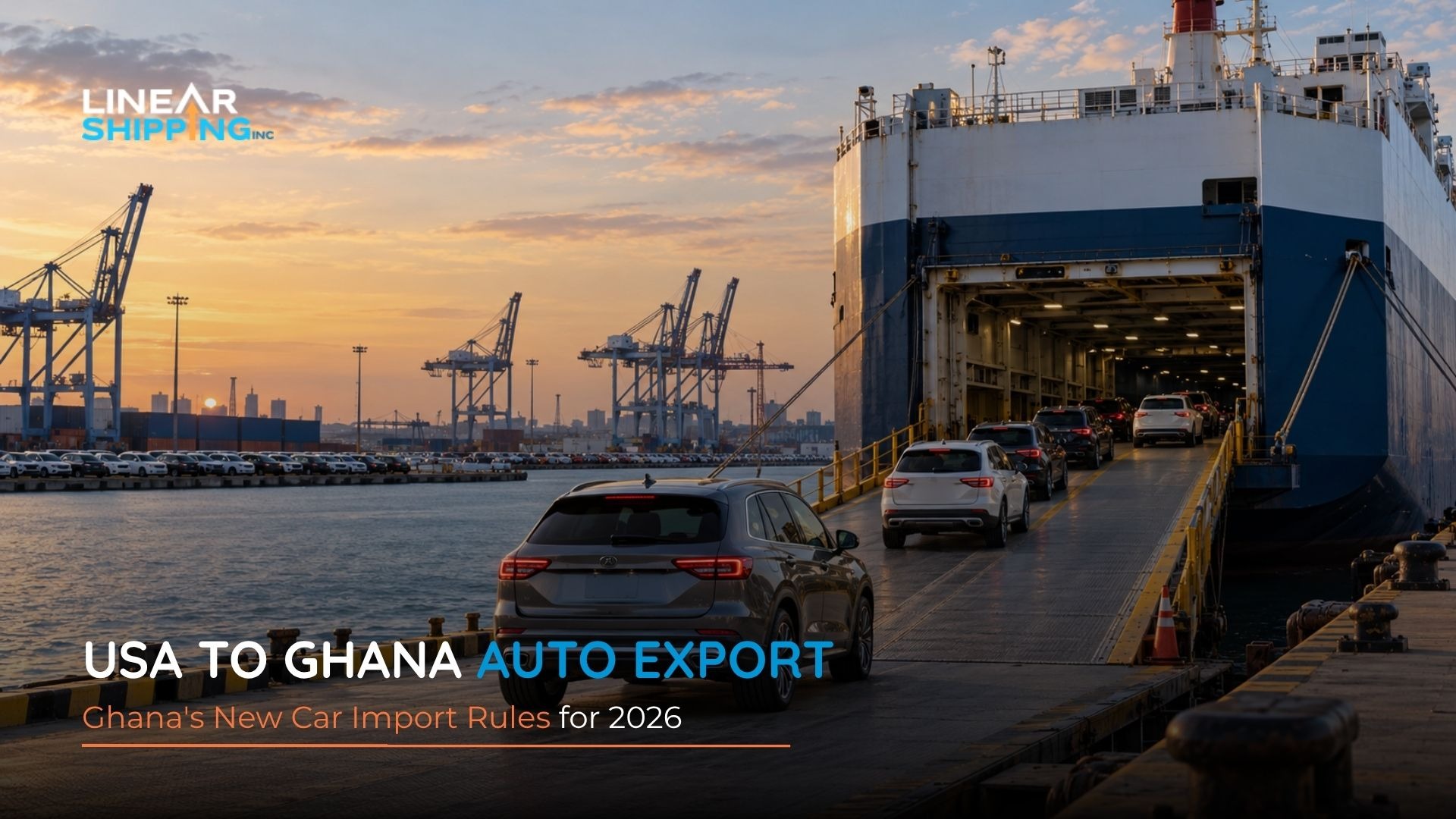
To ship a car from the USA to Ghana, buy the vehicle, file Electronic Export Information through the Automated Export System, and book RoRo or container ocean freight into Tema or Takoradi. Transit runs roughly 28 to 45 days door to door. From 1 October 2026 the Ghana Standards Authority requires every used vehicle to be inspected in the exporting country by a GSA-approved body and to arrive with a Certificate of Conformity, and used vehicles more than 15 years old are prohibited. A separate Ghana Revenue Authority overage penalty still applies to vehicles more than 10 years from the year of manufacture, so eligibility and duty are two different questions.
Ghana is one of the steadiest destinations in West Africa for vehicles bought at United States auctions. Dealers in Accra, Tema, Kumasi and Takoradi source sedans, SUVs and pickups from Copart, IAAI and Manheim because the American auction market supplies the volume and the model mix Ghanaian buyers want. The lane itself is straightforward compared with the harder North African routes, with direct sailings from the US East Coast and Gulf into Tema, and it forms part of the wider corridor for shipping cars from the USA to West Africa alongside Lagos and Cotonou.
What changed in 2026 is the compliance side. Ghana has moved the decision point on whether a vehicle can enter the country from the port of arrival to the port of departure. That single shift rewrites how a buyer should approach an auction bid, and it is the reason a car that would have cleared last year may now be refused. This guide covers the lane end to end for dealers, exporters and importers: the new standards regime and the date it starts, the two age thresholds that get confused with each other, Tema and Takoradi, how the duty stack is built, transit expectations, and the US export steps that cannot be skipped.
What changes on 1 October 2026
The Ghana Standards Authority is beginning strict enforcement of the National Vehicle Homologation and Conformity Assessment Programme on 1 October 2026. The programme has existed since 2020, but enforcement of the applicable national vehicle standards, including Ghana Standard GS 4510 covering requirements for the importation of used vehicles, starts on that date. The Authority set out the framework in Public Notice No. GSA/DGS/PN/26/09, issued on 14 August 2026, which supersedes its earlier notice on the same subject.
The practical change is the location of the inspection. Rather than assessing a vehicle after it lands, every used vehicle must now be inspected in its country of origin by a third-party inspection body approved by the Ghana Standards Authority, which issues a Certificate of Conformity confirming the vehicle meets the applicable Ghana Standards. Vehicles that do not meet the prescribed requirements will not be permitted entry on arrival. For a US exporter that means the compliance question moves ahead of the bid rather than behind the bill of lading.
The Authority has been explicit that this is not a ban on used vehicle imports. The stated purpose is to keep unsafe, substandard and environmentally harmful vehicles out of the market while allowing compliant units through as before. Alongside the inspection requirement, used vehicle importers, distributors and dealers, as well as new vehicle manufacturers and assemblers, are required to register with the GSA Vehicle Homologation Unit.
The exemption that matters right now. The Ghana Standards Authority has confirmed that vehicles shipped before 1 October 2026 are not affected by the new requirements even if they arrive in Ghana after that date, and vehicles already in Ghana before the date are similarly exempt. The trigger is the shipping date, not the arrival date, which leaves a narrow window for units already committed under the old rules.
Ghana's two age thresholds and why they get confused
Almost every dispute about Ghanaian vehicle age comes from treating one rule as if it were two, or two rules as if they were one. Ghana operates two separate age tests, administered by two different agencies, and they produce two different outcomes.
The first is an eligibility test. Under the Ghana Standards Authority notice of 14 August 2026, used vehicles more than 15 years old are prohibited from importation into Ghana from 1 October 2026. This threshold replaced an earlier requirement that would have barred vehicles more than 10 years old from the same date, revised after stakeholder engagement. A vehicle that fails this test is not permitted entry, and no payment resolves it.
The second is a cost test. The Ghana Revenue Authority applies an overage penalty on top of standard duty for vehicles more than 10 years from the year of manufacture, with reported rates rising the older the vehicle gets. A vehicle that fails this test can still be imported, but it lands with a materially higher bill. Age is measured from the year of manufacture rather than first registration, so a car built in late 2015 and registered in early 2016 is treated as a 2015 vehicle.
Verify before you bid. Reporting on the age threshold has been inconsistent because the underlying standard and the superseded August notice both referenced a 10-year prohibition while the current notice sets 15 years. Confirm the applicable threshold and the current overage bands with the Ghana Standards Authority or a licensed Ghanaian clearing agent for the specific vehicle before committing funds.
Vehicles Ghana will refuse regardless of age
Age is only one of the tests under GS 4510. Several categories of used vehicle are prohibited outright, and these matter far more to auction buyers than the age rule because damaged units are exactly what the US salvage market supplies cheaply. Under the standard, the following are barred from importation into Ghana:
- Water and flood damaged vehicles. Any vehicle that has been submerged in water or damaged by floods. A detailed flood car can present well and still carry hidden corrosion and electrical faults, which is precisely what the standard targets.
- Fire damaged vehicles. Any vehicle burnt or damaged by fire.
- Structural damage. Vehicles with broken, cracked, bent or twisted chassis or safety cage structures. Minor cosmetic damage on an otherwise roadworthy vehicle is a different matter from a compromised frame.
- Vehicles assembled from spare parts. Units built up from components rather than shipped as complete factory vehicles.
- Right-hand drive vehicles. Originally manufactured right-hand drive vehicles are prohibited. Ghana drives on the right, so left-hand drive is required, and this catches Japanese-market units that circulate in the used trade.
- Speedometers not calibrated in kilometres per hour. A vehicle without a speedometer reading in kilometres per hour does not meet the standard. This is a small detail that becomes a real risk under strict enforcement, and it is worth checking on US-market cars where the kilometre scale may be secondary or absent.
For an exporter working the salvage market, the structural and water damage categories are the ones that change buying behaviour. A repairable-cosmetic unit and a structurally compromised unit can carry similar auction descriptions and very different outcomes at Tema, so the inspection report now has to be read before the bid rather than after the win.
Tema and Takoradi: choosing the destination port
Ghana has two commercial seaports that receive vehicles from the United States, and the choice shapes the routing, the clearing agent and the inland leg.
Tema Port
Tema is Ghana's principal gateway and sits roughly 25 kilometres east of Accra, which puts it within easy reach of the Greater Accra market where most dealers and buyers are concentrated. It is the primary container port on the lane and carries the bulk of North American vehicle arrivals, with a mature ecosystem of customs brokers and clearing agents used to handling US auction units.
Takoradi Port
Takoradi in the Western Region is the secondary gateway and handles a meaningful share of roll-on roll-off volume. It suits consignees in the west and south west of the country and can be the better choice when the final delivery point sits closer to Sekondi-Takoradi or Cape Coast than to Accra. Sailing frequency and service options differ from Tema, so the routing should be confirmed against actual schedules rather than assumed.
The destination port has to be fixed with the consignee before the booking is made. It determines which clearing agent handles the file, which duty payment channel is used, and how far the vehicle travels inland after release. Changing the port after the bill of lading is issued is expensive and slow.
RoRo or container on the Ghana lane
Both methods work into Ghana, and the right answer depends on the vehicle rather than a general preference.
| Consideration | RoRo | Container |
|---|---|---|
| Vehicle condition | Must start, steer and brake to be driven on and off | Accepts non-running and salvage units loaded by winch or forklift |
| Typical use | Running auction cars and single units moving on schedule | Higher-value vehicles, multiple units sharing a box, damaged units |
| Spare parts | Loose items are not permitted inside the vehicle | Declared parts can travel with the vehicle in the container |
| Exposure | Vehicle is handled and parked on open decks | Vehicle is enclosed and braced for the full voyage |
| Ghana routing | Takoradi carries significant RoRo volume | Tema is the primary container gateway |
The practical rule on this lane is that a clean running unit going to a dealer in Accra usually moves well by either method, while a non-runner, a high-value vehicle or a consignment of several cars for the same buyer normally belongs in a container. The trade-offs between the two methods carry across most auto export markets, and the same logic that governs choosing between RoRo and container shipping for car exports applies here with Ghana's port split layered on top.
What builds the landed cost into Ghana
There is no single headline number for this lane, because the landed cost is assembled from separate components that each move independently. Understanding the structure is what allows a buyer to price a deal accurately before bidding.
The freight side
On the US side the cost is built from inland transport to the port, terminal and export handling, export documentation, and the ocean freight itself, which varies with the method chosen, the size and condition of the vehicle, and the sailing. Auction location matters more than buyers expect, because a car won two states away from the loading port carries an inland leg that a car won near the port does not. The variables that drive this side of the equation are the same ones covered in detail in the breakdown of what determines international car shipping costs.
The Ghana side
Ghana assesses duty on the CIF value of the vehicle, meaning cost, insurance and freight to the Ghanaian port. Critically, the Integrated Customs Management System applies a Home Delivery Value reference to establish that figure, so a low auction purchase price does not automatically produce a low assessment. The charges that stack onto the assessed value include:
- Import duty under the ECOWAS Common External Tariff, commonly falling between 5 and 20 percent for vehicles depending on engine capacity, so a small-engine sedan attracts a lower base rate than a large-engine SUV or pickup.
- VAT at 15 percent, together with the National Health Insurance Levy at 2.5 percent and the GETFund levy at 2.5 percent.
- Smaller statutory levies and fees, including the ECOWAS levy, the African Union import levy, and processing and examination fees applied at clearance.
- An overage penalty where the vehicle is more than 10 years from the year of manufacture, applied on top of the normal duty rather than in place of it.
One structural change is worth noting for anyone comparing a 2026 clearance against an older invoice. Under the Value Added Tax Act, 2025, which took effect on 1 January 2026, the National Health Insurance Levy and the GETFund levy are calculated on the VAT base rather than cascading on top of it, and the 1 percent COVID-19 Health Recovery Levy was removed. The exact figures for any given vehicle appear on its customs classification and valuation report, which is the only document that settles the number.
Transit time and US departure ports
Plan on roughly 28 to 45 days door to door from the United States into Ghana. Within that, the ocean leg from US East Coast ports commonly runs about 18 to 30 days into Tema, with Baltimore, New York and New Jersey, Savannah and Jacksonville all serving the lane. Gulf departures from Houston typically run longer, and West Coast departures add several weeks because of the routing across to the Atlantic.
The sailing time is rarely what causes a missed deadline. Consolidation cut-offs at the loading warehouse, the 72-hour US export window, and clearance and delivery at destination all sit around the ocean leg, and a vehicle that arrives at the warehouse a day after a weekly cut-off waits for the next departure. Working backwards from a required arrival date, rather than forwards from an auction win, is the approach that keeps timelines honest. Every estimate here is a planning guide rather than a guaranteed date.
US export requirements before the vehicle sails
The United States regulates used vehicle exports tightly, and this is where most first-time exporters lose time. Electronic Export Information must be filed through the Automated Export System for any used self-propelled vehicle leaving the country, regardless of value, and the filing generates an Internal Transaction Number that must appear on the transport documentation.
For vehicles moving by vessel, the required documentation and the vehicle must be presented to US Customs and Border Protection at least 72 hours before export under 19 CFR 192.2. In practice this means the original title or equivalent proof of ownership has to be in hand and lodged well before the cut-off, not on the day of loading. A missing title, a title still showing a lienholder without a release letter, or a late filing will hold the vehicle at the terminal and roll it to the next sailing. The mechanics of the filing, the data elements required and the penalty exposure are set out in the full guide to AES filing for vehicle exports.
Declared values also need to be accurate. Understating a vehicle's purchase price to reduce duty at destination is export fraud under US law, and the practice creates exposure for the exporter as well as the buyer.
Documents for Ghana clearance and DVLA registration
A clean file at Tema generally contains the original title with no outstanding lien, the auction or commercial invoice showing the vehicle identification number and value, the bill of lading, the AES filing with its Internal Transaction Number, and from 1 October 2026 the Certificate of Conformity issued by a GSA-approved inspection body. The consignee's identification and tax details are needed on the Ghana side for the customs declaration.
Consistency across these documents matters more than any single one of them. The VIN, the declared value, the consignee name and the vehicle description have to match across the invoice, the bill of lading, the export filing and the certificate. A mismatch is the most common reason a file stalls at destination, and it is entirely avoidable at origin.
Customs clearance is not the last step. After release, the vehicle must be registered with the Driver and Vehicle Licensing Authority before it can be used on Ghanaian roads, and third-party insurance is required for road use. Buyers who budget only to the port gate are routinely surprised by this final stage.
The auction to Tema process, step by step
- Confirm eligibility first. Check the model year against the current age threshold, confirm the vehicle is left-hand drive, and read the damage description against the prohibited categories before bidding.
- Arrange the pre-shipment inspection. For shipments from 1 October 2026, book the inspection with a GSA-approved body in the United States and secure the Certificate of Conformity before the vehicle is loaded.
- Move the vehicle to the loading point. Collection from the auction yard, condition photographs at pickup, and delivery to the terminal or consolidation warehouse.
- File the export documentation. AES filing, Internal Transaction Number, and presentation to CBP at least 72 hours before the vessel sails.
- Load and sail. RoRo onto the vessel or loading and bracing into the container, then the ocean leg into Tema or Takoradi.
- Clear and deliver. Declaration through the customs system, duty assessment and payment, release, inland delivery, and DVLA registration.
Each step has a dependency on the one before it, which is why a vehicle bought without checking eligibility can stall the entire chain. Buyers who export vehicles bought at US auctions regularly tend to run the eligibility and inspection steps as a fixed part of their bidding routine rather than as a follow-up task.
Common mistakes on the USA to Ghana lane
- Treating the 10-year and 15-year rules as the same rule. One decides whether the vehicle can enter, the other decides what it costs. Confusing them produces either an unnecessary rejection or an unbudgeted penalty.
- Buying a right-hand drive unit. It is prohibited regardless of condition, age or value, and no clearance strategy fixes it.
- Budgeting duty on the auction price. Ghana assesses on its own reference value, so a bargain purchase does not guarantee a low assessment.
- Leaving the Certificate of Conformity until after loading. The inspection happens in the exporting country before shipment, so a vehicle already on the water cannot be retrospectively certified.
- Missing the 72-hour US export window. The vehicle rolls to the next sailing, which on this lane can mean a week or more of lost time.
- Document mismatches. A VIN typo or an inconsistent consignee name between the invoice and the bill of lading will hold the file at destination while storage accrues.
Every item on that list is a planning problem rather than a shipping problem, which is the part a licensed forwarder is supposed to control. Mapping the eligibility, the inspection, the routing and the destination clearance for a specific vehicle before booking is what keeps this lane predictable, and you can start that conversation about your shipment once you have the vehicle details, the destination city and the consignee information in hand.
Frequently asked questions
Can I still ship a car from the USA to Ghana after 1 October 2026?
Yes. The Ghana Standards Authority has stated that the new regime is not a ban on used vehicle imports. From 1 October 2026 the vehicle must be inspected in the exporting country by a GSA-approved third-party inspection body and travel with a Certificate of Conformity showing it meets the applicable Ghana Standards. Vehicles that fail the assessment will not be permitted entry on arrival, so eligibility now has to be settled before the car is bought rather than after it lands.
What is the age limit for importing a car into Ghana?
Ghana applies two separate age thresholds and they do different jobs. Under the Ghana Standards Authority public notice of 14 August 2026, used vehicles more than 15 years old are prohibited from importation from 1 October 2026, which is an eligibility rule enforced at the port. Separately, the Ghana Revenue Authority applies an overage penalty on top of normal duty for vehicles more than 10 years from the year of manufacture, which is a cost rule rather than a bar. Because the earlier notice and the underlying standard referenced a 10-year prohibition, the current threshold should be confirmed with the GSA or a licensed Ghanaian clearing agent before purchase.
What is a Certificate of Conformity and who issues it?
A Certificate of Conformity is the document confirming that a used vehicle meets Ghana Standard GS 4510 before it is shipped. It is issued in the exporting country by a third-party inspection body approved by the Ghana Standards Authority, following a physical pre-shipment inspection of the vehicle. Without a valid certificate the vehicle is not permitted entry, so the inspection has to be booked and passed before the car is loaded rather than after the vessel sails.
Which port in Ghana receives cars from the USA?
Tema is Ghana's main gateway for vehicles arriving from North America and sits about 25 kilometres east of Accra, which makes it the default for buyers in Accra and the southern regions. Takoradi in the Western Region is the secondary option and carries a meaningful share of RoRo volume, and it can suit consignees in the west of the country. The destination port should be fixed with the consignee before booking because it determines the clearing agent, the inland leg and the sailing options.
How long does it take to ship a car from the USA to Ghana?
Plan on roughly 28 to 45 days door to door from the United States to Ghana. The ocean leg from US East Coast ports commonly runs about 18 to 30 days to Tema, Gulf departures from Houston typically run longer, and West Coast departures add several weeks because of the routing. Consolidation cut-offs, transshipment and clearance at destination sit on top of the sailing time, so these ranges are planning guides rather than guaranteed dates.
Is RoRo or container better for shipping a car to Ghana?
RoRo suits vehicles that start, steer and brake, because the car is driven on and off the vessel and no container space is bought. Container suits non-running units, higher-value cars, and shipments where several vehicles share the box or declared spare parts travel with the car. On the Ghana lane, Tema is the primary container gateway while Takoradi handles significant RoRo volume, so the method and the port are usually chosen together rather than separately.
How is import duty calculated on a car in Ghana?
Ghana assesses duty on the CIF value of the vehicle rather than the price paid at auction, and the Integrated Customs Management System applies its own Home Delivery Value reference to set that figure. Import duty follows the ECOWAS Common External Tariff and commonly falls between 5 and 20 percent depending on engine capacity, and VAT at 15 percent, the National Health Insurance Levy at 2.5 percent and the GETFund levy at 2.5 percent are applied along with the ECOWAS levy, the African Union levy and processing and examination fees. An overage penalty is added for vehicles more than 10 years old, and the exact assessment appears on the customs classification and valuation report for the specific vehicle.
What documents are required to export a car from the USA to Ghana?
A Ghana-bound vehicle export generally needs the original title with no outstanding lien, the auction or commercial invoice showing the VIN and value, the bill of lading, the Electronic Export Information filing with its Internal Transaction Number, and from 1 October 2026 the Certificate of Conformity from a GSA-approved inspection body. US Customs and Border Protection requires the documentation and the vehicle to be available at the port of export at least 72 hours before the vessel sails, and consignee details must match across every document to avoid a hold at Tema.
Team Linear Shipping
Team Linear Shipping
Linear Shipping Inc. is a Houston-based FMC-licensed freight forwarder and auto export company shipping vehicles from the United States to Ghana and the wider West Africa corridor, with RoRo and container routing into Tema and Takoradi and local clearing agents at destination.