RoRo vs Container vs Flat Rack: Vehicle and Equipment Shipping Compared
What is the difference between RoRo, container, and flat rack shipping?
RoRo shipping drives a running vehicle onto a vessel on its own wheels and is the cheapest option for operable cars and trucks. Container shipping seals the unit inside a 20-foot or 40-foot box, protecting it and allowing non-running units to ship. Flat rack shipping loads oversized, over-height or very heavy equipment onto an open platform by crane when it will not fit a standard container. The right method depends on the unit's size, condition and value.
When a vehicle or a piece of machinery has to cross an ocean, the first real decision is how it travels. Most guides frame this as a straight choice between roll-on roll-off and container, which works well for ordinary cars but leaves out the units that matter most to equipment exporters: the excavators, generators, oversized trucks and irregular machinery that fit neither a RoRo ramp cleanly nor a sealed box at all. That is where the third method, the flat rack, earns its place, and why the honest comparison is a three-way one.
This guide sets RoRo, container and flat rack side by side across the factors that actually decide the booking: how each method loads, what it fits, how the cost is built, which one suits a given unit, where each is available, and how the paperwork differs. By the end you should be able to look at any vehicle or machine and know which of the three is the right answer.
RoRo shipping: how it works, what it fits, where it is available
Roll-on roll-off is the simplest method to picture. The vehicle is driven, or towed, onto a dedicated vehicle vessel on its own wheels, parked on the cargo deck, and lashed down for the voyage, then rolled off at the destination. There is no box and no crane. The unit itself is the cargo, and the rate is based on the deck volume it occupies rather than its weight.
RoRo fits any running, self-propelled unit: cars, SUVs, pickups, buses, and wheeled or tracked machinery that can move under its own power or be safely towed aboard. It is the lowest-cost method for operable vehicles and the backbone of high-volume dealer traffic. The trade-offs are that the unit sits on an open deck rather than being enclosed, and that a non-running vehicle generally cannot use RoRo because it cannot drive aboard. Availability is the other constraint: dedicated RoRo services run frequently on major automobile lanes but are thin or absent on many secondary routes, so the method is only an option where a carrier actually sails it. For ordinary cars this is often the starting point, and the classic choice between RoRo and container for cars usually comes down to protection and lane availability.
Container shipping: 20ft, 40ft, sealed cargo and non-runners
Container shipping loads the vehicle inside a standard 20-foot or 40-foot box, where it is blocked, braced and sealed for the voyage. A single car fits comfortably in a 20-foot container, while a 40-foot unit can carry two vehicles, or up to four with specialized racking, which is how dealers split the cost of a box across multiple units.
The method's strengths are protection and flexibility. Full enclosure shields the unit from weather, salt and handling, which matters for high-value, classic and delicate vehicles. Just as importantly, a container accepts non-running units, because the vehicle can be winched or pushed into the box rather than driven aboard, which makes container the default for salvage and project vehicles that RoRo will not take. Container service is also the most widely available of the three methods, reaching almost any port with a container terminal. The limit is dimensional: the unit has to fit inside the box, so anything wider or taller than the internal opening needs a different answer. The broader mechanics of international auto shipping lean heavily on container precisely because of this combination of protection, reach and non-runner capability.
Flat rack shipping: when the vehicle or machine will not fit a standard box
A flat rack is a specialized platform container: a flat steel bed with strong corner posts and collapsible or fixed end walls, but no side walls and no roof. That open design is the whole point, because it lets cargo be loaded from the top or the sides by crane and secured with lashing, rather than driven aboard or pushed through a door. Flat racks come in 20-foot and 40-foot sizes, including a 40-foot high-cube version, and they carry very high payloads, well into the tens of thousands of kilograms.
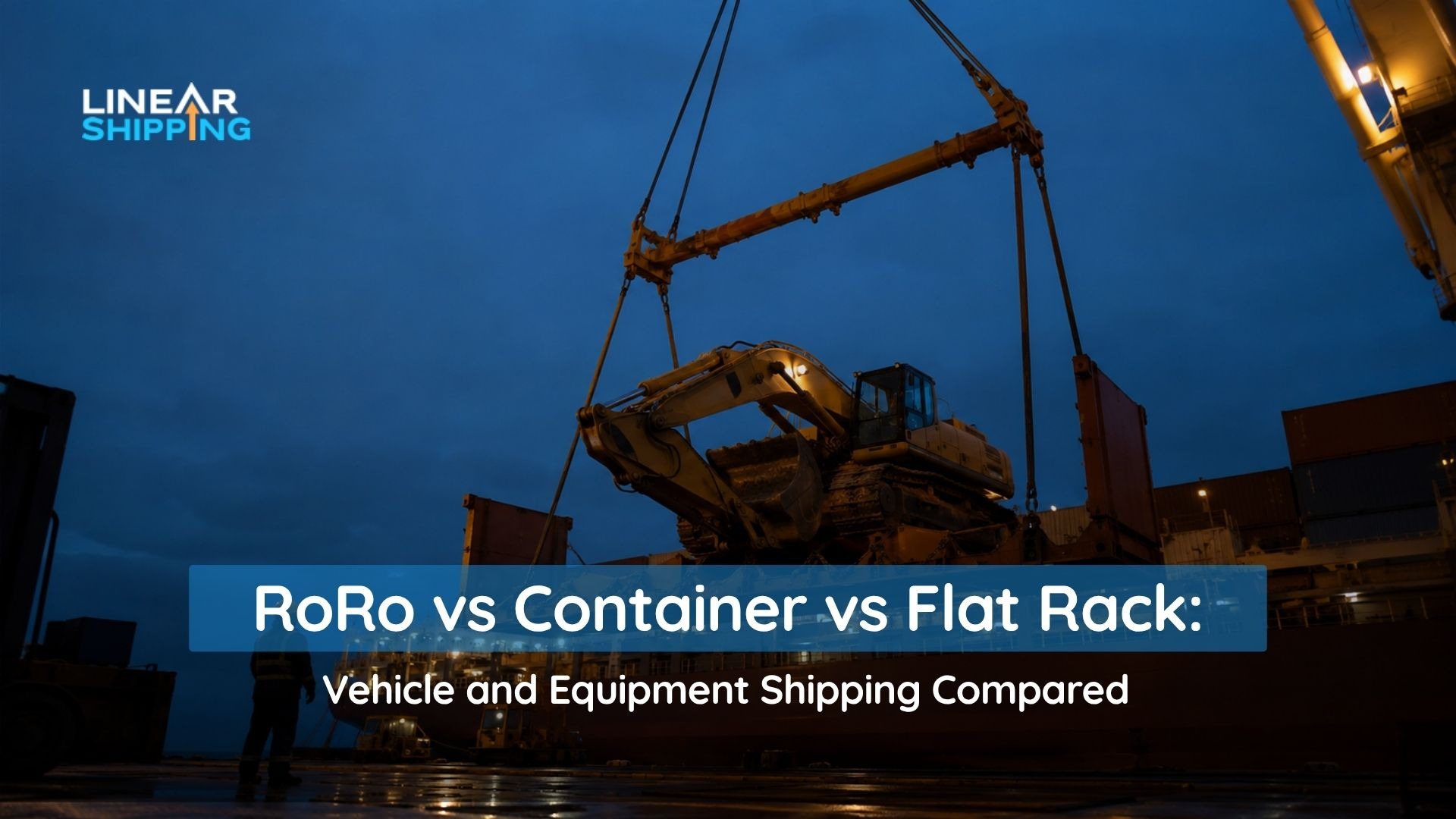
Flat rack is the answer for out-of-gauge cargo, the units that exceed the width, height or weight a standard container or RoRo deck can take. Excavators, bulldozers, cranes, generators, turbines, boats, oversized or lifted trucks and irregular project pieces all travel this way. Because the cargo often overhangs the standard container footprint, carriers apply out-of-gauge surcharges, and a flat rack shipment costs more than a comparable standard box. The upside is that it makes the impossible possible: a machine that fits no container and cannot roll onto a RoRo vessel can still cross an ocean securely on a flat rack. The securing itself is a skilled, safety-critical job, which is why proper method statements and rigging matter, and why anyone moving this kind of cargo should understand what goes into safely loading heavy equipment before it ships.
The three-way comparison at a glance
| Factor | RoRo | Container (20/40ft) | Flat rack |
|---|---|---|---|
| How it loads | Driven or towed aboard on its wheels | Loaded and sealed inside the box | Crane loaded on an open platform, lashed down |
| Best for | Running cars, trucks, buses, self-propelled units | Cars, SUVs and units that fit a sealed box | Oversized, over-height, over-width or very heavy units |
| Protection | Open deck, secured but exposed | Fully enclosed and sealed | Open and exposed, secured with lashing |
| Non-running units | Generally not suitable | Suitable, winched or pushed in | Suitable, crane loaded |
| Relative cost | Lowest for running vehicles | Moderate, flat per-box rate | Highest, with out-of-gauge surcharges |
| Availability | Dedicated services on major lanes | Widest, almost any container port | Where crane and project handling exist |
Cost structure compared across all three
The three methods are priced on different logic, which is why a single unit can carry very different numbers depending on how it moves.
RoRo is billed on the deck volume the vehicle occupies, with no container to pay for, which makes it the cheapest route for a running standard vehicle. Container is priced as a flat rate for the whole box, so the per-unit cost falls sharply when two or more vehicles share a 40-foot container, and the sealed protection is built into that rate. Flat rack sits at the top of the range, because out-of-gauge cargo attracts surcharges for the extra deck space it blocks, plus the specialized crane handling and lashing the load requires.
A useful rule follows from this. If a unit runs and fits a RoRo service on the lane, RoRo is usually cheapest. If it needs protection, is a non-runner, or shares a box with other units, container tends to win on value. Flat rack is not chosen to save money, it is chosen because the cargo fits nothing else, and where a load can be broken down to fit standard containers, that is almost always cheaper than paying out-of-gauge rates.
Which method for which unit: a decision matrix
The fastest way to choose is to match the unit to its most common answer, then adjust for condition, value and lane.
| Unit | Typical best method | Why |
|---|---|---|
| Sedan (running) | RoRo, or container for protection | Drives aboard cheaply; container if the lane lacks RoRo or the car is high value |
| SUV (running) | RoRo or container | Fits both comfortably; the same protection and lane logic applies |
| Pickup (standard) | RoRo or container | Drives aboard, but a lifted or oversized pickup can exceed box height and need a flat rack |
| Excavator | RoRo if drivable, otherwise flat rack | Small units may drive or tow aboard; larger or wide units go out of gauge on a flat rack |
| Generator (static) | Container if it fits, otherwise flat rack | Cannot roll aboard, so it is boxed when it fits or crane-loaded on a flat rack when oversized |
The pattern is consistent: running and standard sized favors RoRo, protection or non-running favors container, and oversized or very heavy forces a flat rack. For a mixed fleet of vehicles and machinery, structured heavy equipment shipping often blends methods across a single program, moving cars by RoRo or container while the outsized units ride flat racks.
Port availability by method and destination region
Method availability is not uniform around the world, and it often decides the choice as much as the cargo does.
- Container is the most widely available by a wide margin, reaching virtually any port with a container terminal, which is why it is the safe default when a destination has thin specialized service.
- RoRo concentrates on established automobile lanes. It is strong into West Africa, the Middle East, the Mediterranean and parts of Latin America, but limited or unavailable on many secondary routes, so it has to be confirmed lane by lane.
- Flat rack depends on ports with crane and project-cargo handling. Major gateways handle it routinely, while smaller ports may require transshipment through a hub with the right equipment.
The practical takeaway is that the destination can override the ideal method. A unit that would suit RoRo may have to ship in a container simply because no RoRo service reaches the port, and an oversized machine bound for a smaller port may route through a larger hub that can handle the flat rack.
Documentation differences
All three methods share a common export core. A vehicle needs its title, every shipment needs a commercial invoice and a bill of lading, and US exports require an Electronic Export Information filing through the Automated Export System with its Internal Transaction Number before loading. Beyond that base, the methods diverge.
- RoRo centers on the vehicle export documents and the unit's running condition, since it has to move under its own power.
- Container adds container-level paperwork such as the verified gross mass declaration, and packing details for how the unit is secured inside the box.
- Flat rack carries the heaviest documentation load, because out-of-gauge cargo needs exact dimension and weight declarations, a lashing and securing plan, and sometimes a stowage approval, all of which feed the carrier's handling and safety requirements.
The heavier the cargo and the further it sits outside standard dimensions, the more engineering detail the paperwork carries, which is one more reason oversized moves reward an experienced forwarder.
How to choose the right method and get it moving
Choosing well comes down to three questions answered in order: does the unit run, does it fit a standard container, and is a suitable service available on the lane. A running, standard vehicle on a RoRo lane takes RoRo. A non-runner, a high-value car, or a unit sharing a box takes a container. A machine that exceeds the box or cannot roll aboard takes a flat rack. Condition, value and destination then fine-tune the answer.
Because the right method depends on the exact unit and the exact lane, the cleanest way to lock it in is to size the cargo against the options before booking, and you can start that conversation about your unit and destination as soon as you have the dimensions, weight and condition in hand. Getting the method right the first time is what keeps an oversized or high-value move from becoming an expensive correction at the terminal.
Frequently asked questions
What is flat rack shipping and when is it used?
Flat rack shipping uses an open platform container with a flat bed, corner posts and collapsible or fixed ends but no side walls or roof, so cargo can be loaded by crane and lashed down. It is used for out-of-gauge cargo that will not fit a standard container or roll onto a RoRo vessel, such as excavators, generators, turbines, boats and oversized or lifted trucks.
Which is cheapest: RoRo, container, or flat rack?
For a running, standard-sized vehicle, RoRo is usually the cheapest because it is billed on deck volume with no container to pay for. Container is moderate and becomes very competitive when two or more vehicles share a 40-foot box. Flat rack is the most expensive because out-of-gauge cargo attracts surcharges and specialized handling, so it is chosen out of necessity rather than to save money.
Can heavy equipment ship by RoRo?
Yes, if the equipment is self-propelled or can be safely towed and fits within the vessel's deck height, it can be driven or towed aboard a RoRo vessel. Larger or wider machines that exceed those limits, or static equipment that cannot roll, ship instead on a flat rack, which is crane loaded and secured on an open platform.
What method should I use for an oversized truck?
A standard truck that runs and fits within RoRo deck limits can ship by RoRo, and one that fits a container can ship boxed. An oversized truck that exceeds standard height or width, such as a lifted or specialized unit, generally needs a flat rack, which handles the extra dimensions with crane loading and lashing rather than a sealed box.