Shipping US Auction Cars to Libya: Luxury to Salvage, All Ports
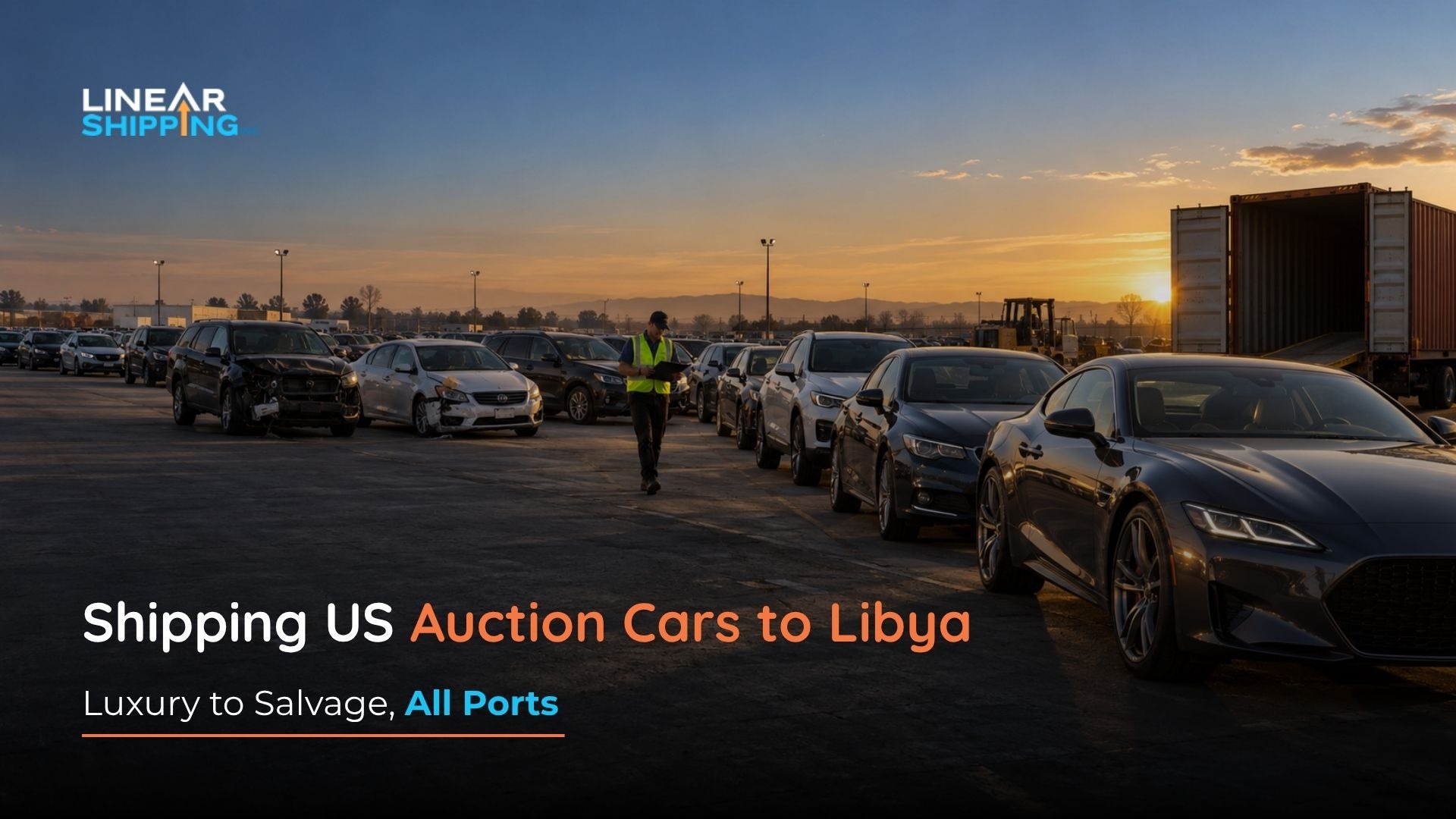
US auctions supply the full range of vehicles Libyan buyers want, from luxury cars to clean-title daily drivers to salvage and damaged units, and all of them can be shipped to every Libyan port. Auction bidding runs through a licensed exporter, most cars travel by container because it handles running, non-running and salvage vehicles alike, and the destination port is chosen to match the consignee's region across western and eastern Libya. The vehicle's title type and condition decide the method and the paperwork.
Libya's car market runs largely on US auction supply. The volume, the variety and the price points found at Copart, IAAI and Manheim make American auctions the natural sourcing ground for Libyan dealers and buyers, and the vehicles they want span the entire spectrum: flagship luxury cars and SUVs at one end, clean-title used cars in the middle, and a heavy flow of salvage and lightly damaged units at the other. What ties them together is that a single, well-run process can move any of them, from a pristine coupe to a repairable wreck, to any port in the country.
This guide is built around that spectrum. It covers how vehicles are sourced from US auctions for Libya, what the different title types mean for an export, how the right shipping method changes with the car's value and condition, how cars are routed to Libya's various ports, and the workflow and paperwork that carry an auction win all the way to a Libyan consignee. It is the sourcing-and-condition companion to the rest of the Libya lane.
Sourcing cars from US auctions for the Libyan market
The three big platforms behind this trade are Copart and IAAI, which specialize in salvage and insurance vehicles, and Manheim, which handles a large volume of clean dealer and fleet cars. Between them they list everything from late-model luxury vehicles to repairable damage cars, which is exactly the range Libyan buyers source.
The catch is access. These auctions restrict bidding to registered dealers and licensed brokers, so an individual buyer in Libya cannot simply bid directly on most lots. In practice the buyer works through a licensed exporter that holds auction access, sets a budget and target vehicles, and has the exporter bid, win and collect on their behalf. That arrangement matters because it closes the gap between the auction win and the port, where storage fees and relocation costs otherwise pile up while an unrepresented buyer scrambles to move the car.
Understanding auction title types and what they mean for Libya
Because so many auction cars are insurance or salvage units, the title type is central to this trade, and it drives both the price and the export handling.
- Clean title. A vehicle with no reported major damage history, typically dealer or fleet cars, and the simplest to export and clear.
- Salvage title. A vehicle an insurer declared a total loss, usually repairable, and the backbone of the Libya auction trade because of the value on offer.
- Rebuilt or reconstructed title. A salvage vehicle that has been repaired and re-inspected, sitting between salvage and clean in both price and paperwork.
- Parts-only or non-repairable title. A vehicle sold for parts rather than road use, which can still be exported but must be declared as such and never presented as roadworthy.
For Libya specifically, salvage and rebuilt vehicles are imported in large volume, so the trade is well established, but the title status must be declared accurately on every document. Misdeclaring a salvage car as clean is the kind of paperwork error that causes holds and disputes, and it is entirely avoidable with an honest, consistent title description from the auction invoice through to the bill of lading.
Matching the shipping method to the vehicle's condition
One of the strengths of this lane is that a single method, the container, flexes across the whole spectrum, which is why it is the standard for Libya while dedicated roll-on roll-off service is limited.
Running, clean-title cars ship efficiently in containers and can share a 40-foot box, two or more to a container, to split the cost. Salvage, damaged and non-running units are ideally suited to containers too, because a car that cannot drive can be winched into a sealed box rather than needing to roll aboard a RoRo vessel, and declared spare parts can travel alongside it. Luxury and high-value cars sit at the top of the range and call for an enclosed, sole-use container, and the enclosed, fully insured approach set out for luxury car shipping to Libya is what protects that end of the spectrum properly.
Condition also shapes the cost, not just the method. A non-runner needs winch handling, a luxury car needs enclosed space, and a consolidated pair of clean cars shares a box, so two auction wins of similar price can land at very different totals. Reading a quote against the real factors that shape international car shipping costs is what lets a buyer judge whether a number reflects the vehicle in front of them or a generic estimate.
Shipping to all ports in Libya
Auction vehicles can be routed to any Libyan port, and the right one depends on where the consignee is and, because the country is administratively divided, which authority will process the car. Western Libya and eastern Libya are run by rival administrations, and customs handling differs between them, so the destination port has to be fixed with the buyer before booking.
| Port | Region | Role for auction cars |
|---|---|---|
| Misrata | Western | The primary vehicle gateway, with the most developed clearing ecosystem for US auction cars |
| Al Khums | Western | A container alternative convenient for buyers around Tripoli |
| Tripoli | Western | General and some container cargo, less specialized for vehicles |
| Benghazi | Eastern | The main eastern gateway for buyers across the Cyrenaica region |
| Tobruk | Eastern | A secondary eastern option for the far east of the country |
The practical point is that the same auction car can be sent to whichever port serves the buyer best, but the routing, the local agent and the customs authority all follow from that choice, so it is made first, not last.
The auction-to-Libya workflow, step by step
- Win the lot and secure the title. The exporter bids and wins at Copart, IAAI or Manheim, then confirms the title type and ownership before the car moves.
- Collect and stage. The vehicle is transported from the auction yard to a staging warehouse, with winch-equipped transport for non-runners and salvage units.
- File the export declaration and screen the parties. The US export filing is completed and all parties are screened against restricted-party lists before the car is committed to a carrier.
- Load by condition. The vehicle is loaded into a shared, dedicated or enclosed container according to its value and condition, secured and sealed.
- Sail and transship. The container moves through a Mediterranean hub and onto a feeder for the final leg into the chosen Libyan port.
- Clear and release. The local agent submits the customs entry, duties are paid on the assessed value, and the car is released to the consignee.
This same auction-sourcing model is what moves US vehicles on other lanes too, so the process a buyer learns for Libya carries over to a destination like shipping a car to El Salvador, with only the destination-side rules changing. The pipeline itself, from auction win to sealed container, stays the same.
Documentation and compliance for auction exports
Auction cars carry a documentation burden that leans heavily on the title, and getting it consistent is what keeps a shipment clean.
- Original title, clear of liens, with the exact title type declared, salvage described as salvage, never dressed up as clean.
- Auction invoice or bill of sale, showing the VIN, lot details, condition and value.
- US export filing, and getting the AES filing right matters because the exporter remains responsible for its accuracy even when a forwarder submits it.
- Original bill of lading and the Libyan cargo tracking note, with the consignee named exactly as Libyan customs expects.
- Consignee identification, for a recognized Libyan importer.
Two compliance points apply across the spectrum. Every party should be screened against US restricted-party lists before shipping, since Libya has been subject to sanctions programs, and the vehicle must still meet Libya's used-car age rules, which generally limit passenger cars to about 5 years from manufacture, so an over-age salvage bargain can be ineligible no matter how good the auction price looked.
Choosing a forwarder that handles the full spectrum
Because this trade runs from luxury to salvage and touches every Libyan port, the operator has to be equally comfortable with a pristine flagship car and a winch-loaded wreck. A capable exporter holds auction access, files the export declaration itself, runs its own staging facility, and can move any title type to any Libyan port under one accountable process. Working through the checks in how to choose a car export company is the fastest way to confirm you are dealing with a licensed operator rather than a broker who will pass your car and your title down an anonymous chain.
That single-thread control is the real advantage of structured auto export, because the party you booked with is the one responsible for the car from the auction floor to the Libyan quay. For a trade built on mixed conditions and split destinations, that accountability is what turns a complicated pipeline into a repeatable one.
Frequently asked questions
Can I ship salvage and damaged cars from US auctions to Libya?
Yes. Salvage, rebuilt and damaged vehicles are among the most commonly imported cars into Libya, and they ship well in containers because a non-running unit can be winched into a sealed box rather than driven aboard. The salvage title must be accurately declared, the vehicle must still meet Libya's age and eligibility rules, and the consignee must be a recognized Libyan importer.
How do I buy a car from a US auction like Copart to ship to Libya?
Auctions such as Copart, IAAI and Manheim restrict bidding to registered dealers and brokers, so most overseas buyers purchase through a licensed exporter that holds auction access and bids on their behalf. The exporter wins the lot, collects the vehicle and the title, and moves it straight into the export process, which closes the costly gap between the auction win and the port.
Can auction cars be shipped to all ports in Libya?
Yes. Auction vehicles can be routed to any of Libya's ports, including Misrata and Al Khums in the west, Tripoli, and Benghazi and Tobruk in the east. Because Libya is administratively split between western and eastern authorities, the destination port sets which customs authority processes the car, so it must be fixed with the consignee before booking.
Does the shipping method depend on whether the car runs or is salvage?
Yes. Container is the standard method for the Libya lane, and it suits salvage and non-running units because they can be winched into a sealed box. Running clean cars can also share a container to split the cost, while luxury and high-value cars call for an enclosed, sole-use container. RoRo service to Libya is limited, so container handles the full range from salvage to luxury.
What vehicle title types can be exported from the USA to Libya?
Clean, salvage and rebuilt titles are all exported from the USA to Libya, and salvage vehicles make up a large share of the trade. Parts-only or non-repairable titles can also be exported, but their status must be declared accurately. Whatever the title type, the original document must be clear of liens and match the export filing and the bill of lading exactly.