What Is Palletized FAK? How Mixed Cargo Moves on Pallets in Ocean Freight
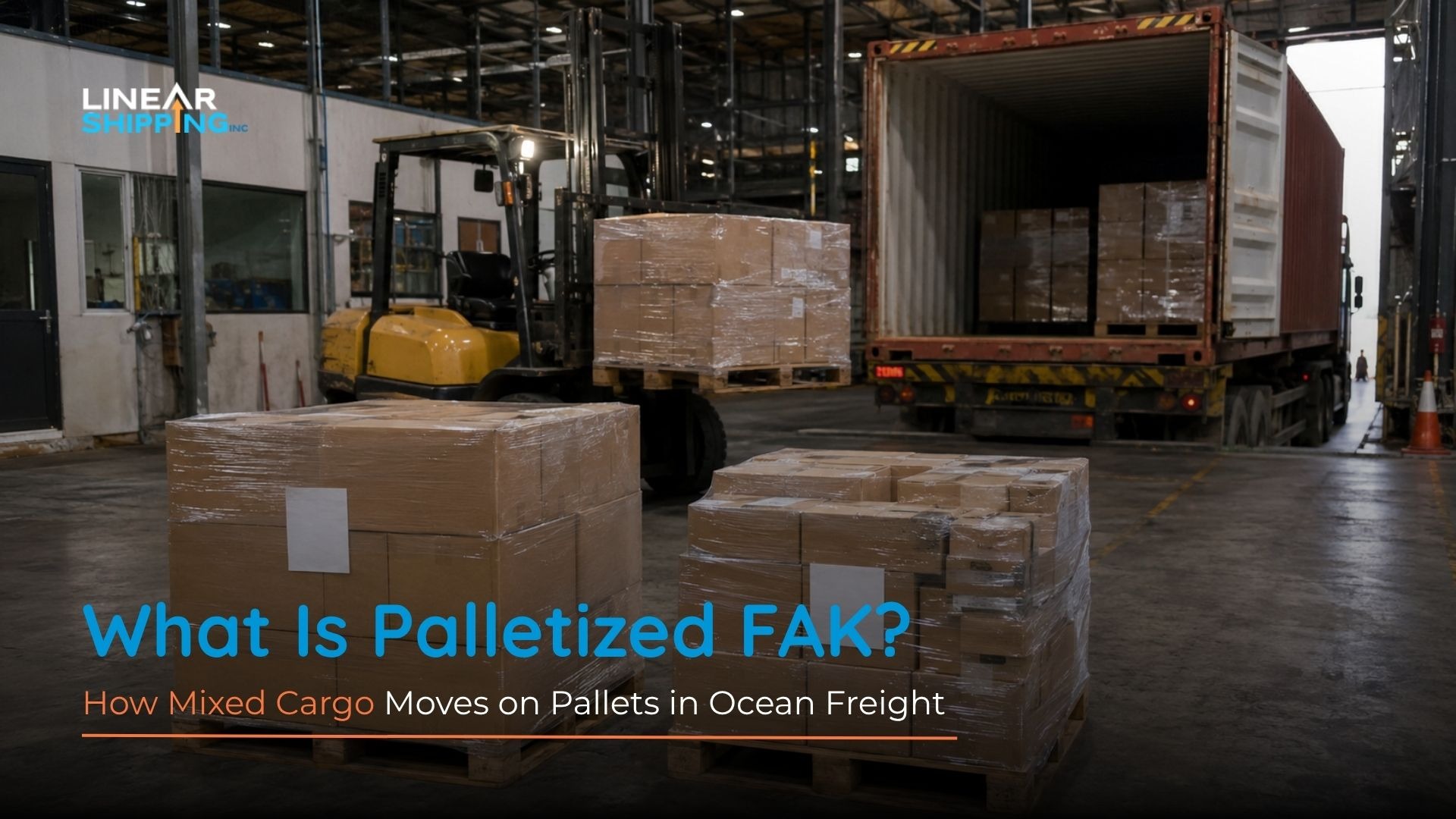
Palletized FAK is a Freight All Kinds (FAK) shipment where each shipper's cargo is loaded onto standard shipping pallets before arriving at the Container Freight Station (CFS) for consolidation into a shared container. The palletization requirement exists because FAK consolidations combine cargo from multiple shippers in the same container, and pallets allow the warehouse team to handle, stack, weigh, and segregate each shipper's portion efficiently and safely. Most FAK consolidators require or strongly prefer palletized cargo over loose-loaded cargo for LCL FAK submissions. Pallet specifications in ocean freight typically follow 48 x 40 inch (GMA) or 1200 x 1000 mm (standard international) dimensions, with a maximum stacking height that fits within the consolidator's container loading plan.
Linear Shipping Inc. | Business Category
Published: May 2026 | Author: Linear Shipping Content Team
The term "palletized FAK" combines two concepts that are often understood separately but rarely explained together. Shippers familiar with Freight All Kinds know what FAK means as a rate classification. Shippers familiar with container logistics know what palletization means in a warehouse context. Where the two interact — at the Container Freight Station, in the consolidation workflow, on the packing list — is where most of the practical questions arise.
This guide explains precisely what palletized FAK is, why palletization requirements exist in FAK consolidations, what the physical and documentary standards look like, and what shippers need to prepare before submitting cargo to a FAK consolidation program.
1. What "Palletized FAK" Actually Describes
Palletized FAK describes a Freight All Kinds shipment where the cargo has been loaded onto pallets before it arrives at the consolidation facility. It is not a distinct shipping product or a separate carrier offering. It is a description of the physical state of the cargo at the point of consolidation.
To understand why palletization matters in the FAK context, it helps to start with what FAK consolidation physically involves.
In a standard FAK LCL (Less than Container Load) consolidation, multiple shippers hand over their cargo at a Container Freight Station. A consolidator or NVOCC combines those separate shipments from different shippers into one shared container. Each shipper only pays for the space their cargo occupies. The container is then sealed and shipped under the consolidator's Master Bill of Lading.
For this process to work cleanly, the consolidator's warehouse team needs to be able to handle, weigh, measure, stack, and segregate each shipper's cargo quickly and without confusion. That is where pallets come in. A pallet turns a collection of individual cartons, bags, or components into a single, manageable, clearly identifiable unit that can be weighed at intake, moved by forklift, stacked in a planned configuration, and verified against the packing list before the container is sealed.
When a shipper delivers cargo to a FAK consolidation facility on pallets, they are not just following a physical requirement. They are making the consolidator's job possible at the scale and speed that makes FAK economically viable. Understanding the complete framework of what FAK is as a rate structure, and how the consolidation rate is separate from the physical handling requirement, is covered in the overview of Freight All Kinds commodity classification.
2. Why Palletization Is Part of the FAK Consolidation Process
Palletization is not arbitrary. It exists because of specific operational requirements that arise when multiple shippers' cargo occupies the same container.
Weight verification at intake. When cargo arrives at the CFS, the warehouse team weighs it to verify against the packing list and to generate the accurate weight entry for the Bill of Lading and the AES/EEI export filing. A palletized load can be weighed in one forklift pass. A loose pile of mixed cartons requires individual counting, stacking, and often re-handling. In a high-volume CFS processing shipments from dozens of shippers on the same departure date, palletized cargo moves through intake in minutes while loose cargo takes significantly longer.
Forklift handling throughout the warehouse cycle. From the point of intake through staging, through loading into the container, and at the destination CFS for deconsolidation, each pallet travels as a single unit. The forklift operator handles the pallet once per step rather than handling individual cartons. This reduces the number of handling events and the corresponding opportunity for damage or loss.
Stacking and space planning. A FAK container is loaded according to a container loading plan that accounts for each shipper's cargo weight, volume, and fragility. The loading team arranges pallets in a configuration that maximizes space utilization while respecting cargo compatibility and weight distribution requirements. Pallets with standard dimensions allow the loading team to plan the container configuration in advance. Loose cargo of varying shapes and sizes makes container loading planning much harder to execute accurately.
Cargo segregation by shipper. In an LCL FAK container, multiple shippers' cargo occupies the same physical space. The cargo must be clearly segregated so that at the destination CFS, each shipper's goods can be identified and separated without confusion. Palletized cargo with clear labeling on each pallet provides this segregation reliably. Loose cargo with individual carton labels in a mixed container is significantly more difficult to segregate accurately during deconsolidation.
Damage liability clarity. When damage is discovered during transit or at deconsolidation, palletized cargo with intake condition documentation allows the claim to be traced to a specific event in the handling chain. Loose cargo without pallet-level documentation makes damage attribution much harder, which is why consolidators and cargo insurance underwriters both favor palletized loads.
3. The Container Freight Station and How Palletized Cargo Moves Through It
The Container Freight Station is the physical facility where FAK LCL consolidation happens. Understanding what happens at the CFS explains why palletized cargo is handled so differently from loose cargo.
When palletized cargo arrives at the CFS, the intake process follows a sequence:
Arrival and check-in. The pallet arrives at the receiving dock. The warehouse team scans or records the shipping marks, compares the physical count to the packing list, and notes any visible damage. A warehouse receiving receipt is generated confirming the pallet has been received and its condition at intake.
Weight and measurement verification. The pallet is moved to a weighing area by forklift and its gross weight is recorded. Dimensions are measured or confirmed against the shipper's declared CBM. These figures go into the consolidation booking record and into the Bill of Lading data.
Staging by departure date and destination. The pallet is moved to the staging area corresponding to its outbound vessel and destination. In a busy CFS, hundreds of pallets from different shippers may be staged simultaneously. Clear pallet labeling with the shipper's booking reference, destination, and handling instructions ensures the right cargo ends up in the right container on the right departure date.
Container loading. On the loading day, the pallets for a specific container are pulled from staging and loaded according to the container loading plan. Heavy pallets typically go in first, along the container floor, with lighter pallets stacked on top where structurally appropriate. The loading team fills the container in a sequence that minimizes wasted space while respecting the weight distribution and stacking limits for each pallet.
Container sealing and documentation. When loading is complete, the container is sealed. A packing list confirming all pallets loaded and their shipper references is generated. This document reconciles against the Master Bill of Lading and each shipper's House Bill of Lading.
At the destination, the process runs in reverse at the destination CFS. The container is deconsolidated, each pallet is identified by its shipper label, and each consignee's goods are released against their House Bill of Lading.
The relationship between FAK as a rate classification and LCL as the fill method that makes multi-shipper CFS consolidation possible is explained in detail in the comparison of FAK and LCL shipping structures, which covers how the two concepts interact but describe different dimensions of the same shipment.
4. Standard Pallet Specifications in Ocean Freight FAK
Pallet specifications in ocean freight are not universally standardized, but practical conventions exist that most consolidators and CFS facilities work within. Shippers who are unfamiliar with these specifications sometimes arrive at a CFS with non-standard pallets that create loading problems.
GMA Pallet (48 x 40 inches / 1219 x 1016 mm). The Grocery Manufacturers Association pallet is the dominant standard in U.S. domestic logistics and is widely used in ocean freight consolidations from U.S. ports. It fits efficiently within the width of a standard 40-foot container and allows four-way fork entry.
International Standard Pallet (1200 x 1000 mm). The ISO 6780 standard pallet is widely used in international trade lanes, particularly in European and Asian markets. U.S.-origin FAK consolidations typically use GMA pallets, but shippers sourcing materials internationally may encounter 1200 x 1000 mm pallets in their supply chain.
Euro Pallet (1200 x 800 mm). The EUR/EPAL pallet is the European standard and is sometimes encountered in import consolidations, though less common in U.S.-origin FAK programs.
Maximum height. Most CFS facilities work with a maximum loaded pallet height of approximately 1.5 to 1.8 meters (59 to 71 inches) including the pallet base. This limit exists because of container internal height and the practical stacking requirements of the loading plan. Pallets exceeding this height may need to be split into two pallets or restructured before intake.
Weight limits. A standard GMA wooden pallet supports a static load of approximately 2,500 to 3,000 kg (5,500 to 6,600 lbs), though the practical limit per pallet in a FAK consolidation depends on what can be safely stacked on top of it and what the forklift capacity at the CFS supports. Shippers with unusually heavy cargo per pallet should confirm the CFS's handling capability before delivering.
Heat treatment certification. Most international shipments require phytosanitary compliance for wooden pallets. In the United States, wooden pallets used in international shipments must comply with ISPM 15, the international standard for wood packaging material, and must bear the appropriate heat treatment (HT) or heat treatment and debarked (DB) stamp. Pallets without ISPM 15 compliance may be refused at destination customs or subject to treatment or destruction.
Shippers who are considering FAK consolidation for the first time and need to understand how the rate structure interacts with these physical handling requirements will find the FAK pricing strategy framework useful for understanding the commercial side of what palletization supports.
5. Palletized FAK vs Loose-Loaded FAK: What the Difference Means Operationally
Not all FAK consolidations require palletization, and some cargo types are inherently non-palletizable. Understanding the difference between palletized and loose-loaded FAK clarifies what to expect from each approach.
Palletized FAK is the standard and preferred approach for most FAK LCL consolidations at U.S.-origin CFS facilities. Cargo is presented on pallets with shrink wrap or strapping securing the load to the pallet deck. The CFS handles the entire pallet as a unit through intake, staging, loading, and deconsolidation.
Loose-loaded FAK describes cargo that arrives at the CFS as individual cartons, bags, crates, or items without being assembled onto pallets. The CFS team must handle each piece individually, which increases labor time, increases the number of handling events, and creates more complexity in cargo segregation.
Some cargo is inherently loose: large machinery components that cannot be palletized due to their shape, odd-sized crates that do not fit standard pallet dimensions, or items that are too heavy for a pallet but too small for their own container. These cargo types move under FAK as loose items when the consolidator accepts them under those terms.
The practical consequence for shippers choosing between palletized and loose submission is that palletized cargo typically moves through CFS intake faster, generates fewer handling-related damage events, and is easier to document and reconcile against the packing list. Consolidators who accept loose cargo often apply a handling surcharge that accounts for the additional labor time required.
The decision about whether cargo should move as palletized FAK or loose cargo also connects to whether the shipment qualifies as LCL or whether FCL container options should be considered. That decision framework is a separate evaluation that depends on volume, cargo compatibility, and destination, all of which are relevant to how FAK functions across different consolidation structures.
6. What a Mixed Pallet Load Looks Like in Practice
To make the palletized FAK concept concrete, consider a realistic example of a U.S. exporter shipping a mixed commercial order to a distributor in Dubai.
The shipment. A trading company is exporting three product categories to a single consignee: packaged consumer electronics accessories (phone cases, cables, screen protectors), industrial spare parts (small machined metal components in bags), and household goods (folded textiles in cartons). The total shipment is 4.2 CBM and fits on two GMA pallets.
Pallet 1: Electronics accessories. Fifteen cartons of consumer electronics accessories are stacked on a GMA pallet, secured with stretch wrap. Each carton is labeled with the shipper's name, booking reference, HS code, destination, and carton number (e.g., 1/15 through 15/15). The pallet is labeled with the consolidator's booking reference, the consignee's name, and the vessel departure date. Total weight: 380 kg.
Pallet 2: Industrial parts and household goods. The industrial spare parts, packed in smaller cartons, occupy the lower half of the second pallet. The household goods cartons are stacked on top. Both categories are from the same shipper going to the same consignee, so co-loading on one pallet is acceptable. Each carton is labeled individually. The pallet is stretch-wrapped as a unit with the same outer labeling as Pallet 1. Total weight: 520 kg.
At the CFS. Both pallets arrive together on the shipper's delivery. The receiving team checks the two pallet count against the packing list, weighs each pallet, confirms the marks and numbers on the outer labels, and issues a warehouse receiving receipt for two pallets at the confirmed weights. Both pallets are moved to the staging area for the Dubai-bound vessel departure date.
In the container. On loading day, the two pallets are loaded into the 40-foot container alongside pallets from other shippers on the same Dubai departure. The loading plan positions them based on weight and stacking compatibility.
This is palletized FAK in operation: a mixed cargo load, consolidated with other shippers' cargo under a FAK rate, moving through the CFS workflow on pallets that make every handling step cleaner, faster, and more auditable.
Linear Shipping manages FAK consolidations from its warehouses in Houston, Savannah, New York, and Los Angeles, operating under established NVOCC carrier agreements on active trade lanes to the Middle East, West Africa, and Central America. Our FAK consolidation service accepts both palletized cargo and, on a case-by-case basis, loose cargo that meets specific handling criteria.
7. Packing List Requirements for Palletized FAK Shipments
The packing list for a palletized FAK shipment must accurately reflect the contents at the pallet level, not just at the shipment level. This matters because the packing list is used at multiple stages: warehouse intake, Bill of Lading preparation, AES/EEI export filing, and destination customs clearance.
A complete packing list for a palletized FAK shipment includes:
Shipper and consignee details. Full legal names, addresses, and where relevant, tax identification or customs registration numbers for the destination market.
Booking reference. The consolidator's booking reference number that links the packing list to the House Bill of Lading for that shipper's portion of the container.
Pallet count and identification. The total number of pallets in the shipment, with a unique identifier for each pallet (e.g., Pallet 1 of 2, Pallet 2 of 2). Some consolidators require individual pallet labels with their own barcode or reference numbers that match the packing list.
Contents per pallet. For each pallet, a line-by-line description of the cartons or items on that pallet, including quantity, description, HS code, and carton dimensions. This detail is what allows the intake team to verify the physical load against the document, and what allows destination customs to assess duties at the correct classification.
Gross and net weights per pallet. The gross weight includes the pallet itself. The net weight covers the cargo only. Both figures should be stated separately.
Total CBM per pallet. The volume calculation per pallet, used to calculate the ocean freight allocation for that shipper in the consolidation.
ISPM 15 pallet declaration. A statement confirming that the wooden pallets comply with international phytosanitary treatment requirements, with reference to the heat treatment stamp on the pallet.
Incomplete or inaccurate packing lists are one of the most common causes of CFS intake delays and departure misses. A packing list that does not match the physical cargo discovered at weighing requires correction before the warehouse receipt can be issued, which directly affects whether the cargo makes its intended vessel.
8. What Linear Shipping Requires for Palletized FAK Submissions
For shippers submitting palletized FAK cargo to Linear Shipping's consolidation program, the following requirements apply at the time of booking and at cargo delivery.
At booking. Provide the complete packing list with the cargo description, HS codes, quantity, weight, and CBM for each pallet. The packing list must be in a final or near-final state at the time of booking, as it is used to plan the container loading configuration and to prepare the AES/EEI filing.
Pallet specifications. Cargo must be presented on GMA (48 x 40 inch) pallets where possible. Non-standard pallet sizes should be confirmed with the Linear Shipping operations team before delivery. All wooden pallets must carry a valid ISPM 15 heat treatment stamp.
Shrink wrap or strapping. Every pallet must be stretch-wrapped or strapped with the load secured to the pallet deck. A pallet where cartons are stacked but not secured is a liability during handling and will be wrapped at the CFS at a surcharge.
Clear labeling. Each pallet must be clearly labeled on at least two sides with: shipper name, consignee name, booking reference, carton count on that pallet, gross weight, and destination port. Individual carton labels must include carton number within the total count, HS code, and description.
Delivery timing. Palletized FAK cargo must be delivered to the designated CFS warehouse by the cargo receipt cutoff for the booked vessel. Late delivery after the cutoff results in cargo rolling to the next available vessel.
Loose cargo acceptance. Loose cargo is accepted on a case-by-case basis with advance approval from the operations team. Unapproved loose cargo arriving at the CFS may be refused or subject to re-handling surcharges.
These requirements reflect standard CFS practice across the industry and are not unique to Linear Shipping. They exist because the consolidation workflow depends on cargo arriving in a condition that allows it to be processed reliably within the CFS intake and staging timeline.
Frequently Asked Questions
What is palletized FAK in shipping?
Palletized FAK is a Freight All Kinds (FAK) shipment where the cargo has been loaded onto pallets before arriving at the Container Freight Station for consolidation. The palletization requirement exists because FAK consolidations combine cargo from multiple shippers in one container, and pallets allow the warehouse team to handle, weigh, stack, and segregate each shipper's cargo efficiently. The FAK designation refers to the rate classification applied to the cargo. Palletized refers to the physical preparation of the cargo before it enters the consolidation workflow.
Does FAK require cargo to be palletized?
Most FAK consolidators at U.S. CFS facilities require or strongly prefer palletized cargo. It is not a universal regulatory requirement, but it is a standard operational requirement at most facilities because palletized cargo moves through CFS intake, staging, and container loading significantly faster than loose cargo. Loose cargo is accepted on a case-by-case basis and typically incurs additional handling charges. Shippers should confirm the palletization requirements with their freight forwarder before delivering cargo to a CFS.
What pallet size is standard for ocean freight FAK?
The GMA (Grocery Manufacturers Association) pallet at 48 x 40 inches (1219 x 1016 mm) is the dominant standard for U.S.-origin ocean freight FAK consolidations. Internationally, the 1200 x 1000 mm ISO standard pallet is widely used. Most U.S.-based CFS facilities are configured for GMA pallets. Shippers using non-standard pallet dimensions should confirm compatibility with the consolidation facility before delivery.
Can loose cargo move under a FAK rate?
Yes, loose cargo can be rated under FAK, provided it falls within the FAK agreement's approved commodity scope. The FAK designation is a rate classification, not a physical preparation requirement. However, most CFS consolidators apply additional handling surcharges to loose cargo because of the extra labor required during intake, loading, and deconsolidation. Palletized cargo is consistently preferred and in most cases required at U.S. CFS facilities.
How is palletized FAK different from standard LCL?
Palletized FAK and standard LCL are not mutually exclusive. Most LCL shipments that move under FAK pricing are palletized. The distinction is between the rate structure (FAK as the pricing mechanism applied to the cargo) and the fill method (LCL as the container-sharing arrangement). A palletized FAK shipment is an LCL shipment where the cargo is on pallets and the freight rate is a FAK blended rate. Standard LCL without FAK would use commodity-specific rates for each product type rather than a single blended rate.
What ISPM 15 certification is required for wooden pallets in ocean freight?
ISPM 15 is the International Standards for Phytosanitary Measures No. 15, a requirement that wood packaging material used in international trade be treated to eliminate the risk of spreading invasive insects or plant diseases. Wooden pallets used in ocean freight exports from the United States must carry an ISPM 15 mark showing the country code, the treatment provider, and the treatment type (HT for heat treatment). Pallets without ISPM 15 marks can be refused at destination customs or subjected to mandatory treatment or destruction.
What documents are required for a palletized FAK submission?
The core documents required for a palletized FAK submission are: a complete packing list with pallet-level detail (contents per pallet, weight per pallet, CBM per pallet, carton count per pallet), a commercial invoice with accurate cargo descriptions and declared values, and AES/EEI export compliance documentation for U.S.-origin shipments. The packing list must be in a final or near-final state at the time of booking, as it is used for AES filing, container loading planning, and Bill of Lading preparation.
Linear Shipping is an FMC-licensed NVOCC and international freight forwarder based in Houston, TX. We operate FAK consolidation programs from warehouses in Houston, Savannah, New York, and Los Angeles, with established carrier agreements on trade lanes to the Middle East, West Africa, and Central America. Our consolidation team manages palletized FAK submissions, packing list review, AES/EEI filing, and container loading planning as an integrated service.
Linear Shipping Content Team
Linear Shipping Content Team
Linear Shipping is an FMC-licensed NVOCC and international freight forwarder based in Houston, TX. We operate FAK consolidation programs from warehouses in Houston, Savannah, New York, and Los Angeles, with established carrier agreements on trade lanes to the Middle East, West Africa, and Central America. Our consolidation team manages palletized FAK submissions, packing list review, AES/EEI filing, and container loading planning as an integrated service.