Shipping an SUV or Truck to Georgia (Poti): What to Prepare
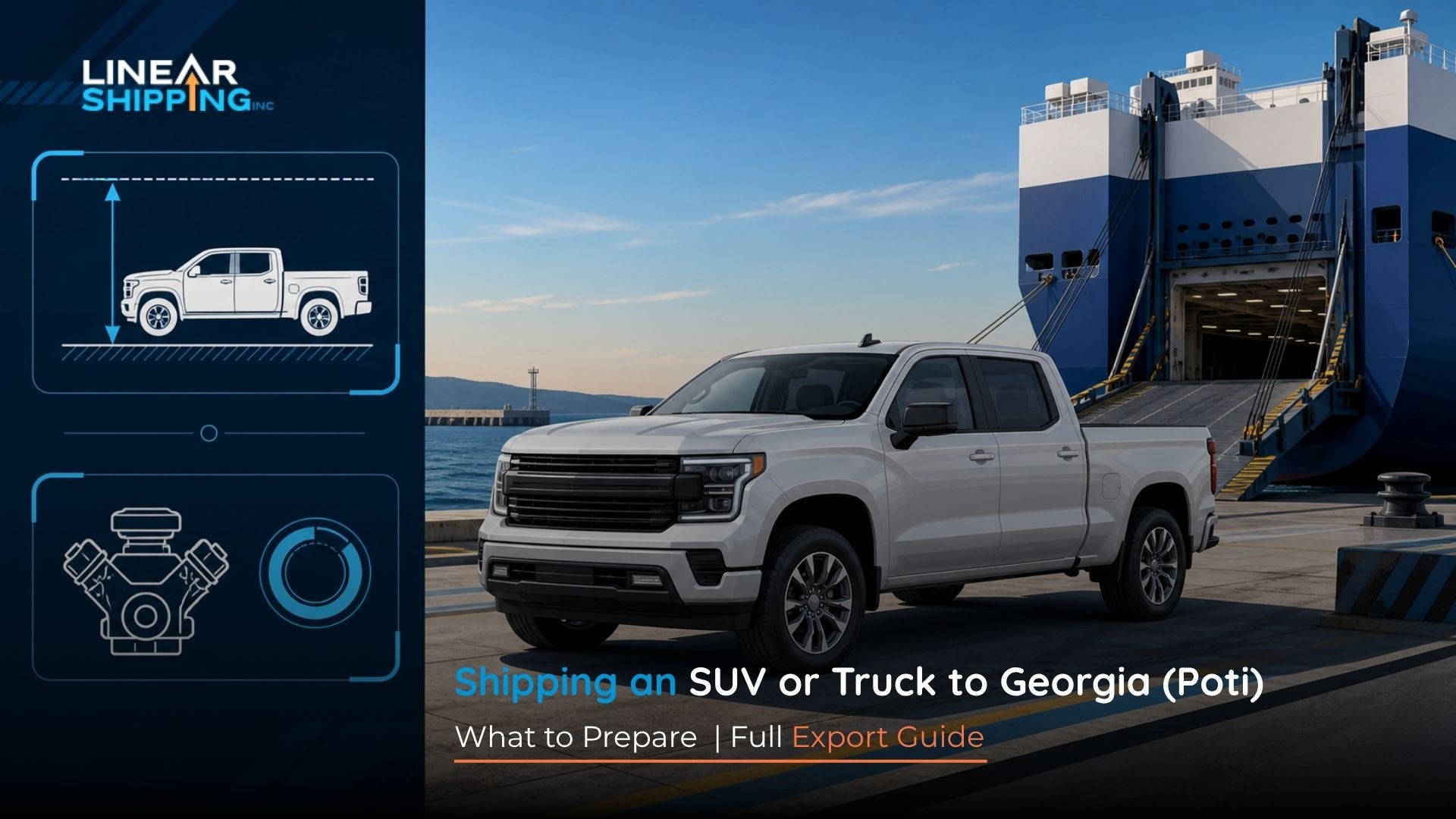
Shipping an SUV or truck from the United States to Poti, Georgia follows the same core export process as a standard car, but with additional preparation requirements driven by the vehicle's size, weight, and engine displacement. Larger vehicles occupy more cubic meters on a RoRo vessel or inside a container, which affects vessel acceptance criteria and loading logistics. Trucks and SUVs also carry larger engines, which increases the Georgian excise tax at destination compared to a sedan with a smaller engine. Before booking, exporters shipping SUVs and trucks to Poti need to confirm accurate physical dimensions, verify carrier acceptance for the specific vehicle type, prepare the vehicle correctly for transit, and account for the excise tax implication of large-displacement engines at Georgian customs.
Linear Shipping Inc. | Export Guide Category
Published: May 2026 | Author: Linear Shipping Content Team
Walk through any active car lot in Tbilisi, Poti, or Batumi, and the pattern is immediately clear. American pickups, full-size SUVs, and crew-cab trucks represent a disproportionate share of the vehicles coming through Georgian ports. The combination of U.S. auction availability, right-hand drive rarity, and the practical demands of Georgian and Central Asian terrain makes American trucks and SUVs among the most commercially valuable vehicles flowing through Poti on an ongoing basis.
For Georgian dealers and individual importers buying these vehicles at Copart, IAAI, or Manheim, the shipping process has important differences compared to exporting a standard sedan. The vehicle's size introduces logistics considerations that do not apply to a compact or midsize car. The engine displacement affects the excise tax calculation at destination customs in a way that can materially change the landed cost. And the physical preparation required before loading a full-size pickup or SUV for ocean transit differs from preparing a smaller vehicle.
This guide addresses those differences directly. It is written for exporters who are already familiar with the Georgia lane in general terms and need the SUV and truck-specific details that a general car shipping guide does not fully cover.
1. Why SUVs and Trucks Are the Most Exported Vehicles to Georgia
Georgia has an unusually high demand for full-size American trucks and SUVs relative to the size of its domestic market. Several factors explain this.
The re-export corridor. Poti functions as a major transit hub for vehicles moving onward into Armenia, Azerbaijan, and Central Asian markets, including Kazakhstan, Uzbekistan, and Kyrgyzstan. American pickup trucks, particularly Ford F-150, F-250, Ram 1500, and Chevrolet Silverado units, are in active demand across these markets for both commercial and personal use. Georgia's import duty structure and the Poti Free Industrial Zone make it one of the most accessible re-export entry points in the region.
American truck availability at U.S. auctions. Copart and IAAI carry a significant inventory of American trucks and SUVs, including salvage, rebuilt, and lightly damaged units that price below the U.S. retail market but retain strong value in Georgian and Central Asian commercial contexts. Dealers who have established auction buyer networks in the United States treat this inventory as a consistent sourcing channel.
Terrain and utility demand. The practical driving conditions across Georgia and neighboring markets favor capable, larger vehicles. Full-size SUVs and trucks are preferred for commercial operators, landowners, and buyers in less urbanized regions where road conditions demand ground clearance and cargo capacity.
Vehicle value relative to shipping cost. The ratio of vehicle value to shipping cost on American trucks and SUVs is typically more favorable than on smaller vehicles. A used full-size pickup purchased at auction for $8,000 to $12,000 carries a much better margin-to-shipping-cost ratio than a compact sedan at half the purchase price.
2. How Vehicle Size Affects the USA to Poti Shipping Process
Size is the central operational difference between exporting a sedan and exporting an SUV or truck. It affects the space the vehicle occupies, the carrier's acceptance criteria, the loading approach, and in some cases the port handling requirements.
Cubic meter (CBM) calculation. RoRo rates and container space are measured in cubic meters (CBM), calculated from the physical dimensions of the vehicle: length multiplied by width multiplied by height. A standard sedan typically occupies approximately 7 to 9 CBM. A full-size crew-cab pickup truck or large SUV can occupy 12 to 16 CBM depending on the specific model and any modifications. That difference in occupied space is directly reflected in the ocean freight cost.
RoRo deck height clearance. RoRo vessels have defined height clearance between decks. Vehicles that exceed the clearance limit for a standard deck must be loaded on higher, more exposed open decks or may not be accepted on a particular vessel entirely. Standard sedan height rarely triggers this issue. Full-size SUVs with stock ride height are generally within acceptance parameters on major carriers. Lifted trucks, SUVs with aftermarket suspension modifications, or vehicles with roof racks, bull bars, or rooftop cargo carriers require dimension verification before booking.
Weight. While ocean freight rates for vehicles are primarily volume-based rather than weight-based, the physical weight of a large SUV or truck affects inland transport costs, forklift requirements for non-running vehicles, and port handling. A non-running F-250 requires different towing and loading equipment than a non-running compact car.
Carrier acceptance policies. Not all ocean carriers accept vehicles of all sizes on all vessels serving the Poti lane. Before confirming a booking for an oversized or lifted vehicle, the freight forwarder must verify acceptance with the specific carrier on the intended departure date.
3. RoRo for SUVs and Trucks on the Poti Lane
RoRo shipping remains the most common shipping method for standard full-size SUVs and running pickup trucks to Poti. The mechanics are identical to sedan RoRo, with size-specific considerations applied at each stage.
Vessel deck assignment. Standard running full-size SUVs and trucks are generally loaded on lower, enclosed decks of RoRo vessels alongside other vehicles. However, taller configurations, including SUVs with lift kits or trucks with extended cab-over toolboxes, may be assigned to open weather decks where vehicles are exposed to the marine environment during transit. This is not a problem for most auction vehicles, but it is a relevant consideration for higher-value units where surface condition on arrival matters.
Fuel level requirement. All RoRo carriers require that vehicles are delivered with a limited fuel level, typically under one-quarter tank. Fuel restrictions exist for safety reasons on board the vessel. Vehicles arriving with more than the permitted fuel level will be either refused or have fuel drained at port, which generates a surcharge and delays the loading schedule.
Driving onto the vessel. For running vehicles, RoRo requires the vehicle to be driven up the stern ramp and positioned on the deck under its own power or with minimal tow assistance. A full-size truck or SUV that runs without mechanical issues is driven on exactly as a smaller vehicle would be. The driver assigned by the terminal follows standard RoRo loading procedures.
Non-running SUVs and trucks via RoRo. Non-running vehicles can move via RoRo on most Poti-serving lanes, but forklift loading is required. Forklifts at RoRo terminals are designed for standard vehicle dimensions and weights. A very large or very heavy truck that pushes the upper limits of standard forklift capacity may present a loading challenge at certain terminals. Container shipping is the simpler and more predictable option for non-running trucks and SUVs.
For dealers managing regular exports of auction trucks to Poti, the RoRo routing from Baltimore and Savannah serves this lane well, with transshipment through Black Sea hubs providing weekly connections to Poti.
4. Container Shipping for SUVs and Trucks to Poti
Container shipping offers specific advantages for SUVs and trucks that make it the preferred method in several common scenarios.
Full-size trucks in 40-foot containers. A standard 40-foot container can typically accommodate one full-size crew-cab pickup truck, with room for additional cargo such as spare parts, tools, or accessories alongside the vehicle, provided the total weight and volume remain within the container's specifications. For exporters including spare parts with the truck shipment, container is the only option since RoRo carriers prohibit items inside vehicles.
Two SUVs in one 40-foot container. Depending on the specific models, two midsize SUVs can often be loaded into a 40-foot container using a ramp-and-stack configuration, with one vehicle loaded on a purpose-built ramp above the other. This consolidated configuration reduces the per-vehicle ocean freight cost and is a common choice for dealers moving two units to the same consignee.
Non-running trucks. For non-running pickup trucks and SUVs, container shipping is the cleaner logistics choice. The vehicle is forklift-loaded into the container at the stuffing facility under controlled conditions, without the terminal-level uncertainty that can arise with non-running vehicles at RoRo terminals. The container is then sealed and transported as standard container cargo.
High clearance and modified vehicles. A lifted pickup truck or SUV with significant ride height modifications may exceed RoRo vessel deck clearance limits. For these vehicles, a container eliminates the clearance issue entirely, since the container itself accommodates the full vehicle height as long as the vehicle fits within the container's internal dimensions.
The choice between RoRo and container for a specific truck or SUV shipment depends on the vehicle's running condition, its dimensions, whether accessories or parts are traveling with the vehicle, and the available consolidation options on the departure date. The full decision framework comparing both methods across all relevant dimensions is covered in the guide to RoRo vs container shipping for vehicle exports, which applies directly to the Poti lane as well as other destinations.
5. Pre-Shipment Preparation Checklist for SUVs and Trucks
SUVs and trucks require specific preparation before they can be accepted for RoRo or container loading. This checklist applies to all vehicles but has line items that are more commonly triggered by larger vehicles.
- Fuel level. Reduce fuel to below one-quarter tank for RoRo shipments. This is a carrier requirement without exception. For container shipments, fuel level requirements vary by carrier and stuffing facility, but below one-quarter tank is standard practice.
- Battery. The battery must be in good enough condition to allow the vehicle to run if it is going via RoRo, or to allow the vehicle to be moved under power during inspection. For container shipments, the battery is typically disconnected after the vehicle is loaded.
- Fluids. No leaking fluids. Carriers reject vehicles with active fluid leaks. Check for oil, coolant, transmission fluid, and brake fluid leaks before the vehicle is transported to the staging warehouse. A leak discovered at the port creates a delay and potential rejection.
- Personal items. The vehicle must be empty. RoRo carriers prohibit any contents inside the vehicle without exception. For container shipments, approved cargo items such as spare parts, tools, and accessories can travel inside the vehicle's bed or cargo area, but they must be declared on the commercial invoice and packing list.
- Aftermarket accessories. Accessories that increase the vehicle's height, width, or weight beyond what was declared in the booking must be either declared accurately at booking or removed before loading. A roof rack, bed cover, oversized tires, bull bar, or winch all affect the vehicle's dimensions. Undeclared modifications that cause a dimension discrepancy at the port create surcharges and potential carrier rejection.
- Tire condition. Tires must be inflated to standard pressure. A vehicle with a flat tire that cannot support its own weight during loading creates a handling problem at the terminal.
- Alarms. Vehicle alarm systems must be deactivated or the deactivation code must be provided to the loading crew. An alarm that activates during vessel loading or transit creates a disturbance on the vessel and can result in battery drain.
- Cleanliness. Some destination countries require vehicles to be free of soil, mud, seeds, and organic matter on the undercarriage to meet agricultural import standards. While Georgia itself does not apply the strictest phytosanitary requirements of some markets, it is good practice to have the undercarriage cleaned, particularly for trucks that have been used off-road.
6. Engine Displacement and Georgian Excise Tax
This section is specifically important for SUV and truck exporters because it affects the total landed cost in a way that is often underestimated.
Georgia calculates excise tax on imported vehicles primarily based on two variables: engine displacement (measured in cubic centimeters or liters) and the vehicle's age.
A standard sedan imported from the United States typically has an engine in the 1.5 to 2.5 liter range. A full-size American pickup truck or body-on-frame SUV commonly has an engine in the 3.5 to 6.2 liter range. The difference in engine displacement between these two categories translates directly into a higher excise tax assessment at Georgian customs, with larger displacement engines attracting meaningfully higher excise obligations.
The practical consequence for dealers importing trucks and SUVs is that the excise tax component of the landed cost is substantially higher for these vehicles than it is for compact or midsize cars, even if the purchase price from the U.S. auction is comparable. A landed cost calculation that ignores the engine-displacement-driven excise difference will systematically underestimate the total acquisition cost for trucks and SUVs.
The 18% VAT applies uniformly regardless of vehicle type or engine size.
The excise tax rate schedule changes periodically, and the rate applicable to a specific vehicle depends on the precise engine displacement, the model year, and the current Georgian customs tariff schedule. Obtaining a destination duty estimate from a local Georgian customs broker or from Linear Shipping's local agent network at Poti before purchasing the vehicle at auction is the most reliable way to build an accurate landed cost.
7. Documentation Requirements for SUV and Truck Exports
The export documentation package for an SUV or truck export to Poti is identical in structure to a standard car export. The vehicle-specific differences are in the details rather than the document types.
Original vehicle title. The title must match the VIN and vehicle description exactly. For auction trucks, the title type (clean, salvage, rebuilt) must be confirmed against Georgian customs acceptance requirements before purchase. Georgia currently accepts salvage titles, but the vehicle's intended use at destination and whether it will be domestically registered or re-exported should be confirmed with the consignee and their customs broker.
Auction invoice or bill of sale. The auction invoice from Copart, IAAI, or Manheim establishes the declared value for AES/EEI filing and for destination customs duty assessment. For high-value trucks, the declared value directly affects insurance premium calculations if marine coverage is included.
AES/EEI filing and ITN. Every vehicle exported from the United States with a declared value above $2,500 requires AES filing and an ITN at least 72 hours before vessel departure. The Schedule B code for the specific vehicle type must be correctly applied. Trucks, SUVs, and specialty vehicles have specific Schedule B classifications that differ from passenger car classifications. Using the wrong code is a filing error that can delay clearance or generate penalties. The compliance requirements and filing process are covered in the AES filing and export compliance guide, which details the deadline structure and what to do when a filing error is identified before departure.
Power of Attorney. A signed POA authorizing the freight forwarder to file AES on the exporter's behalf is required if the exporter is not filing independently.
Commercial invoice. The commercial invoice must accurately describe the vehicle, including make, model, year, VIN, condition, and engine specification. For large-displacement trucks and SUVs, the engine size is a relevant detail for Georgian customs and should be explicitly stated.
Bill of Lading. Issued by the carrier after loading, confirming the shipment terms and consignee details. The vehicle description on the Bill of Lading must match the AES filing.
8. Pickup Trucks and Lifted Vehicles: Special Considerations
Full-size pickup trucks and lifted vehicles deserve a dedicated section because they generate the most frequent bookings and port complications in the USA to the Poti vehicle export lane.
Extended cab and crew cab length. A standard short-bed F-150 has an overall length of approximately 5.7 meters. An extended-cab long-bed F-250 or Ram 2500 can reach 6.5 to 6.8 meters. The longer the vehicle, the more deck space it occupies on a RoRo vessel and the harder it is to fit a second vehicle in a 40-foot container alongside it. When booking a long-bed crew-cab truck for RoRo, confirm with the forwarder that the specific model's length falls within the carrier's acceptance parameters for the booked vessel.
Lifted suspension systems. An aftermarket lift kit of 4 to 6 inches on a truck or SUV can push a vehicle's total height from within the RoRo deck clearance range to beyond it. A stock Ram 1500 stands approximately 1.9 meters tall. A Ram 1500 with a 6-inch suspension lift stands approximately 2.05 to 2.1 meters, which may exceed the deck clearance limit of some vessels on the Poti-serving routes. Confirm the lifted height against the carrier's maximum before booking.
Bed cargo. Pickup truck beds must be empty for RoRo shipments. For container shipments, cargo in the bed is permissible provided it is declared, secured, and within the weight limits. Dealers shipping a truck with spare parts, a replacement engine, or toolbox components in the bed should use container shipping and declare everything on the commercial invoice and packing list.
Winches and external equipment. A truck with a front-mounted winch, a rear hitch receiver with a mounted carrier, or oversize bumpers may have a declared length that does not match the vehicle's actual front-to-back dimension when accessories are included. All protrusions must be measured and declared. The measurement taken at the port is of the physical vehicle as presented, not the stock manufacturer specification.
9. Inland Transport from U.S. Auctions to the Departure Port
Getting a truck or SUV from the auction yard to the departure port is the first operational step, and for large vehicles, it carries logistical considerations beyond what applies to sedans.
Transport carrier type. Standard auto transport carriers (open multi-car trailers) handle most full-size trucks and SUVs without any special arrangement. However, vehicles with lift kits that raise the overall height significantly may not clear the upper deck of a standard auto transport trailer, requiring either single-deck transport or an enclosed carrier at additional cost.
Non-running truck transport. A non-running full-size truck weighing 3,000 to 4,000 kg requires a tow vehicle with appropriate capacity. Standard tow dollies used for compact cars are not appropriate. Winch-capable flatbed towing is the standard approach, and the surcharge for non-running large vehicles is higher than for non-running compact cars.
Port proximity and staging. Linear Shipping coordinates inland pickup from auction locations across the United States and stages vehicles at warehouses in Houston, Savannah, New York, and Los Angeles before vessel loading. For Georgia-bound trucks and SUVs, Baltimore is typically the strongest departure point for RoRo given its established Black Sea routing connections, while Savannah serves container departures effectively.
Dealers buying trucks at auction locations in Texas and surrounding states have efficient routing through Houston for Gulf Coast departures, while buyers sourcing from Midwest or Southeast locations often route through Savannah. The full breakdown of which departure port serves which origin region is covered in the USA to Poti car export guide, which details the port selection logic for this specific trade lane.
Frequently Asked Questions
Can I ship a lifted pickup truck via RoRo to Poti?
It depends on the vehicle's actual height with the lift installed. Standard RoRo vessels serving the Poti lane via Black Sea transshipment hubs have deck clearance limits, and a significant suspension lift may push a truck above the acceptance threshold. The forwarder must confirm the vehicle's exact standing height against the carrier's clearance specifications before booking. If the lifted height exceeds the limit, container shipping removes the clearance constraint entirely.
Does a larger engine on a truck or SUV affect the shipping cost?
Engine size does not directly affect the ocean freight cost, which is primarily calculated on CBM (physical volume). However, engine displacement significantly affects the Georgian excise tax at destination, since Georgia's excise schedule is tied to engine size. A 5.7-liter V8 truck attracts a materially higher excise tax than a 2.5-liter sedan of similar age. This needs to be factored into the landed cost calculation before the vehicle is purchased at auction.
How many vehicles fit in a 40-foot container for Poti?
One full-size crew-cab pickup truck typically fills a 40-foot container on its own when bed and clearance dimensions are accounted for. Two standard midsize SUVs can often be loaded in a single 40-foot container using a ramp-and-stack configuration. Whether a specific pair of vehicles fits depends on the exact models and their dimensions. A freight forwarder experienced in the Poti lane can assess fit based on the specific VINs before the container is booked.
What items can I include in the truck bed for a container shipment?
For container shipments, cargo in the truck bed is permissible provided it is declared on the commercial invoice and packing list, physically secured inside the bed, and within the container's total weight limit. Spare parts, tools, and accessories are commonly shipped this way. RoRo shipments do not permit any contents in the vehicle.
Do I need to remove accessories before shipping a truck to Poti?
Accessories that increase the vehicle's declared dimensions must either be declared accurately at booking or removed before the vehicle is presented for loading. Items such as roof racks, oversized bumpers, and winches affect the vehicle's CBM measurement and may affect RoRo carrier acceptance criteria. Accurately declaring all dimensions including accessories at the time of booking prevents surcharges and rejections at the port.
How do I get an accurate landed cost for a truck or SUV to Georgia?
An accurate landed cost requires: the specific vehicle's physical dimensions for CBM calculation, the engine displacement for Georgian excise tax estimation, the VIN for title status confirmation, the destination (Poti or Batumi) for terminal fee confirmation, and confirmation of the shipping method (RoRo or container). Linear Shipping can provide an itemized export quote covering the U.S. side of the cost, and coordinates with local agents at Poti for destination cost estimates, including customs duties.
Does Linear Shipping handle pickup truck and SUV exports to Poti?
Yes. Linear Shipping manages vehicle exports of all types to Poti from auction pickup in the United States through vessel departure. This includes running and non-running trucks and SUVs, standard and lifted vehicles, and consolidated container loads for dealers moving multiple units.
Linear Shipping is an FMC-licensed NVOCC and international freight forwarder based in Houston, TX. We specialize in vehicle exports from the United States to destinations including Poti and Batumi in Georgia, managing the complete export process from auction pickup and AES/EEI filing through ocean freight booking and destination coordination. Our team handles full-size pickups, SUVs, lifted trucks, and non-running vehicles across all standard RoRo and container methods.