How to Ship Commercial Cargo from Texas to the Middle East
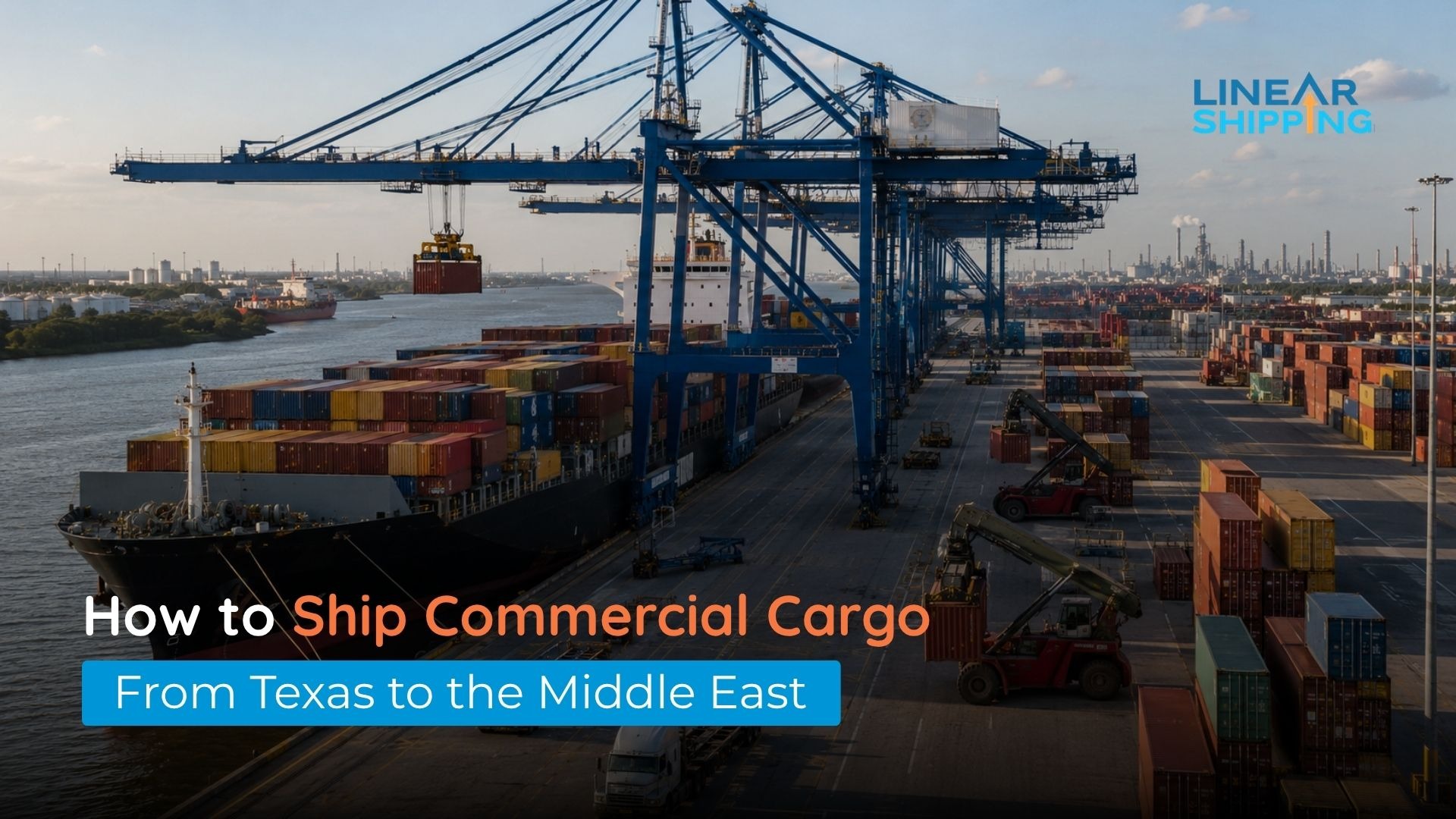
How do I ship commercial cargo from Texas to the Middle East?
To ship commercial cargo from Texas to the Middle East, stage your goods at the Port of Houston, choose a full container load or FAK consolidation depending on volume, file Electronic Export Information through the Automated Export System, and book ocean freight to a Gulf gateway such as Jebel Ali, Dammam, Aqaba or Muscat. A Houston freight forwarder handles the export filing, documentation and booking.
Texas sits in an unusually strong position for trade with the Middle East. The state produces and consolidates an enormous volume of exportable goods, from industrial equipment and oilfield supplies to chemicals, machinery parts, building materials and consumer products, and it sits beside the busiest export gateway in the United States. For a business in Houston, Dallas, San Antonio or anywhere in between, the path to Gulf markets like the UAE, Saudi Arabia, Jordan and Oman runs through a single, efficient corridor that begins at the Houston Ship Channel.
This guide walks Texas-based exporters through that corridor end to end: why the Gulf Coast is the logical launch point, what the Port of Houston can actually handle, the trade lanes that connect it to Middle East ports, how to decide between a full container and consolidation, and the export filing and paperwork that keep a shipment moving instead of stalled. The mechanics are consistent, and once you understand them the lane becomes routine.
Why Texas is a natural Gulf Coast export hub for Middle East cargo
The advantage starts with geography and scale. The Houston Ship Channel complex is the largest port in the United States for waterborne tonnage and ranks first in the nation for export tonnage, which means liner services, equipment and export expertise are concentrated here rather than scattered. For Middle East cargo specifically, that density matters, because frequent sailings and deep carrier coverage translate into more routing choices and steadier schedules.
Texas also produces exactly what Gulf economies buy. The Houston region anchors the largest petrochemical complex in the country and is the leading US gateway for resin exports, while the state's industrial base feeds a steady flow of machinery, oilfield and construction goods toward the same markets that import them. A business shipping out of Texas is moving with the grain of an established trade flow rather than against it, and that is a real cost and reliability advantage. It is also why a Texas exporter benefits from a freight forwarder rooted in the Houston hub, where the carrier relationships and terminal knowledge already exist.
The commodity mix moving on this lane is broad, and most of it originates in or around Texas. Oilfield and energy equipment, pumps, valves and drilling supplies head to Gulf operators. Polymers and specialty chemicals flow from the petrochemical corridor. Industrial machinery, generators and spare parts, construction and building materials, processed foods, and packaged consumer goods all travel the same route. Whether a shipper moves a single recurring product or a varied mix, the destination markets in the UAE, Saudi Arabia, Jordan and Oman are active buyers across nearly all of these categories.
Inside the Port of Houston: container and breakbulk capability
Port Houston operates eight public terminals along the 52-mile Houston Ship Channel, and two of them are built specifically for the cargo most commercial exporters move.
- Container terminals. Barbours Cut and Bayport are the port's two container terminals, among the most efficient in the country. Port Houston is the largest container port on the Gulf of Mexico and handles roughly three quarters of the Gulf Coast's containerized cargo, crossing 4.3 million TEUs in 2025 and continuing to grow into 2026.
- Breakbulk and project cargo. The Turning Basin serves as the upstream hub for breakbulk, and Port Houston runs the nation's leading breakbulk facility. That capability matters for oversized machinery, steel, pipe and project pieces that do not fit a standard box, which are common on the Middle East lane.
Recent channel deepening and widening work, along with new ship-to-shore cranes commissioned at Barbours Cut, have lifted both capacity and the size of vessels the port can take. For an exporter, the practical takeaway is simple: whether your cargo is containerized consumer goods or a breakbulk industrial piece, Houston has a terminal and a service designed for it.
Trade lanes from Houston to the Middle East
The Gulf-to-Gulf corridor connects Houston to every major Middle East gateway, either through direct services or efficient transshipment via Mediterranean and regional hubs. The four ports below cover the bulk of commercial demand from Texas, and the same corridor that carries containers also moves vehicles to the Middle East on the identical routings.
| Destination port | Market served | Indicative transit from Houston | Role on the lane |
|---|---|---|---|
| Jebel Ali | UAE (Dubai) | About 30 to 45 days | Largest port in the Middle East and the region's main transshipment and distribution hub, home to the JAFZA free zone |
| Dammam | Saudi Arabia | About 35 to 50 days | King Abdulaziz Port, the primary Gulf gateway for the Eastern Province and Riyadh |
| Aqaba | Jordan | About 35 to 50 days | Jordan's only seaport and the Red Sea gateway into the Levant |
| Muscat | Oman | About 35 to 50 days | Gateway to the Omani market, served through the country's deep-water container terminals |
Transit windows are indicative and depend heavily on routing. A direct service to Jebel Ali sits at the faster end, while shipments that transship through a hub port to reach Aqaba, Dammam or Muscat run longer. Seasonality, vessel rotation and Gulf congestion can all shift an estimated arrival, which is why a confirmed sailing schedule beats a generic transit estimate every time.
FAK consolidation for mixed commercial cargo from Texas
Not every shipment fills a container, and forcing a partial load into a full box wastes money. This is where consolidation earns its place. A freight all kinds approach groups different commodities from one or more shippers into a shared container under a single blended rate, which lets a Texas business move mixed commercial goods to the Gulf without paying for empty space. For exporters sending pallets of varied products rather than a single uniform load, FAK consolidation often produces the lowest landed cost on the lane.
The method works best when you understand how it differs from a straight per-cubic-meter arrangement, because the right structure depends on your commodity mix, frequency and timing. Knowing how FAK consolidation compares with standard LCL is what lets an exporter pick the cheaper option for a given shipment rather than defaulting to one out of habit. Mixed cargo with a consistent flow tends to favor a freight all kinds program, while one-off partial loads can suit conventional consolidation.
Full container options from Houston
When volume justifies it, a full container load is usually the cleaner and more economical choice. Loading a 20-foot or 40-foot container at origin gives you a sealed unit, fewer touch points, simpler documentation and a more predictable schedule, since the box moves as one consignment from the Houston terminal to the destination gateway. High-volume Texas exporters of resin, machinery, equipment and packaged goods generally default to full container loads for exactly these reasons.
The decision between a full container and consolidation comes down to how much you are shipping and how often. A reliable rule of thumb is that once a shipment approaches roughly two thirds of a container's usable space, a dedicated box tends to win on both cost per unit and handling simplicity. Below that, consolidation keeps the per-shipment cost in check while still reaching the same ports on the same services.
AES and EEI filing for Texas commercial cargo exports
Every commercial export from the United States carries a compliance step that cannot be skipped. Electronic Export Information (EEI) must be filed through the Automated Export System (AES) whenever the value of goods under a single Schedule B classification, shipped to one consignee, exceeds 2,500 dollars, or whenever an export license is required regardless of value. For commercial cargo bound for the Middle East, that threshold is reached on most shipments.
A few points decide whether this step runs smoothly:
- Who files. The US Principal Party in Interest, normally the exporter, is responsible, though an authorized agent such as the freight forwarder usually files on the exporter's behalf.
- Liability stays with the exporter. Delegating the filing does not transfer legal responsibility. The USPPI remains accountable for the accuracy of the data even when a forwarder submits it.
- The ITN is the gate. A successful filing returns an Internal Transaction Number, which is the proof the carrier needs before the cargo is loaded. No valid ITN or exemption citation, no loading.
- File before departure. EEI is a pre-departure requirement, so the Schedule B codes, values and party details need to be ready well ahead of the sailing.
Why this matters on the Gulf lane. Incorrect or missing EEI can hold a shipment at the terminal, delay the vessel booking and expose the exporter to penalties. Getting the Schedule B classification and values right the first time is the difference between a clean departure and a stranded container.
Documentation package for Middle East-bound commercial shipments
Middle East customs authorities are document-driven, and a complete, consistent paperwork set is what keeps a shipment clearing on arrival. While exact requirements vary by destination country, a commercial export from Texas generally needs the following.
- Commercial invoice. Detailed, with accurate descriptions, values and Incoterms.
- Packing list. Itemizing contents, weights and dimensions per package.
- Bill of lading. The carrier's contract and title document for the cargo.
- Certificate of origin. Often required and, for several Gulf states, may need chamber of commerce attestation or legalization.
- EEI proof of filing. The ITN from the AES submission.
- Product-specific certificates. Conformity, health, or other certificates depending on the commodity and the destination's standards regime.
Consistency across these documents is as important as completeness. A description on the invoice that does not match the bill of lading, or a value that conflicts with the EEI, is exactly the kind of discrepancy that triggers an inspection or a hold at the destination port.
One more detail decides who pays for what on arrival: the Incoterms rule stated on the commercial invoice. Whether a shipment moves under terms where the buyer takes responsibility at the origin terminal or terms where the seller delivers further down the chain changes which party covers ocean freight, destination handling, import duty and local clearance. Gulf states apply their own import duties and, in several markets, value added tax, all of which fall outside the export freight itself. Agreeing the Incoterms clearly with the buyer before the cargo ships prevents the most common dispute on this lane, which is a surprise bill at the destination that neither side expected to owe.
How Linear Shipping stages and ships from Houston to the Middle East
A clean export on this lane is mostly about sequencing, and a Houston-based forwarder is built to run that sequence. Cargo is received and staged near the Houston terminals, matched to the right mode of full container or consolidation, and booked onto a confirmed sailing to the chosen Gulf gateway. The export filing and documentation are prepared in parallel so the ITN and paper set are ready before the vessel cutoff, and the shipment is tracked from terminal to destination so any congestion or schedule change is caught early rather than discovered on arrival.
Because everything happens close to the water, the domestic trucking leg stays short and the handoffs stay under one roof, which is where most avoidable cost and delay come from when a shipment is split across several uncoordinated parties. Mapping the right routing for a specific load starts with a short conversation about your destination, commodity, volume and timeline, and you can begin that conversation about your shipment specifics whenever your cargo is ready to move.
Frequently asked questions
How do I ship goods from Texas to the Middle East?
Stage your cargo at the Port of Houston, choose a full container load or FAK consolidation based on your volume, file Electronic Export Information through the Automated Export System to obtain an ITN, and book ocean freight to a Gulf gateway such as Jebel Ali, Dammam, Aqaba or Muscat. A Houston freight forwarder typically manages the filing, documentation and carrier booking on your behalf.
What is the transit time from Houston to Dubai?
Ocean transit from Houston to Jebel Ali, the port serving Dubai, generally runs about 30 to 45 days port to port. Direct services sit at the faster end, while routings that transship through a hub port take longer, and weather, vessel rotation and Gulf congestion can shift the arrival, so a confirmed sailing schedule is more reliable than a generic estimate.
Can I use FAK consolidation for mixed commercial goods from Texas?
Yes. A freight all kinds approach groups different commodities into a shared container under a single blended rate, which lets a Texas business move mixed commercial goods to the Middle East without paying for unused space. It is well suited to varied pallets and steady flows, while a full container load usually wins once a shipment fills most of a box.
What documentation is needed to export commercial cargo from Texas?
A typical Middle East export from Texas needs a commercial invoice, a packing list, a bill of lading, a certificate of origin that may require attestation for some Gulf states, the EEI proof of filing or ITN, and any product-specific conformity or health certificates the destination requires. Keeping descriptions and values consistent across all documents prevents inspections and holds.
What Houston-area freight forwarders serve Middle East lanes?
Because Houston is the top US export port, the region hosts many forwarders that handle Gulf trade, so the choice comes down to genuine Middle East lane experience, carrier coverage to Jebel Ali, Dammam, Aqaba and Muscat, and the ability to file AES and prepare destination documentation. Linear Shipping is a Houston-based freight forwarder that stages, files and ships commercial cargo on these routes.