Car Shipping from USA to Nigeria: Complete Guide for Lagos, Apapa and Tin Can
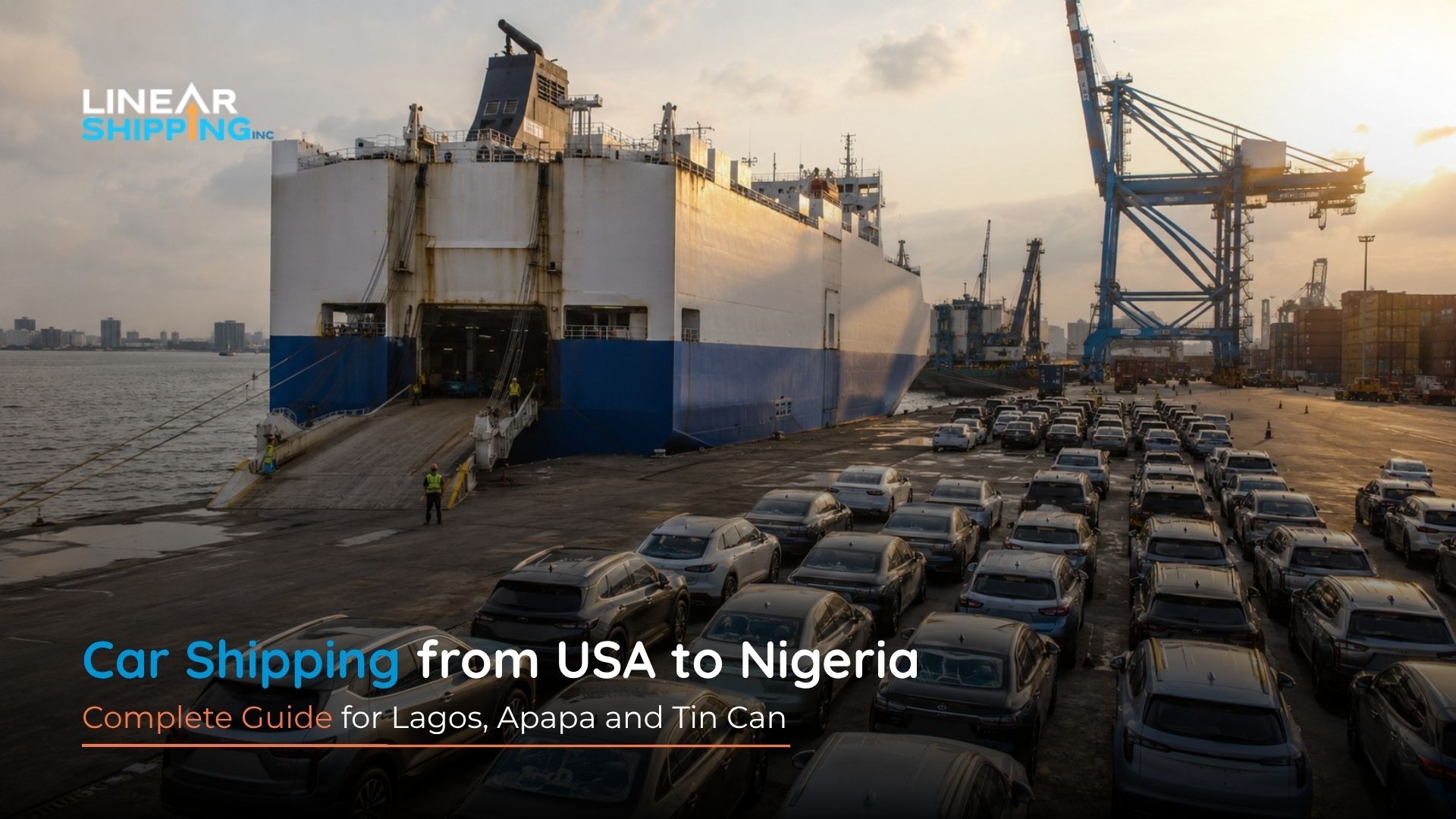
To ship a car from the USA to Nigeria, buy the vehicle at a US auction such as Copart or IAAI, secure the title and a clean bill of lading, move the unit to an export port, and book RoRo or container ocean freight to Lagos. Most cars discharge at Tin Can Island, then clear customs at Apapa or PTML with an approved Form M and PAAR.
Auto Export Guide
By Team Linear Shipping | Houston, Texas
Nigeria runs one of the most active used-vehicle import markets in West Africa, and a large share of that supply starts inside an American auction yard. Dealers in Lagos, Onitsha, Aba and Abuja buy directly from US salvage and wholesale platforms, then route those vehicles across the Atlantic to the Lagos port cluster for resale. The economics work because of price gaps at origin, but the margin only survives if the shipping leg is handled cleanly. Understanding how international auto shipping actually moves a unit from a US yard to a Nigerian berth is what separates a profitable import from a vehicle stranded in demurrage.
This guide walks the full corridor for Nigerian dealers and importers: where the cars come from, how the export workflow runs out of the United States, the two ocean methods that reach Lagos, the difference between Apapa, Tin Can Island and PTML, and the customs rules and duties that decide whether your unit clears or gets seized. Everything below reflects the regulatory picture as of 2026, so treat duty rates and the age cutoff as figures to confirm with the Nigeria Customs Service before you bid.
Why Nigerian dealers buy cars from US auctions
The United States holds the deepest pool of wholesale vehicle inventory in the world, and most of it flows through a handful of online auction platforms. For a Nigerian importer, this is the source layer of the entire trade. The strongest USA car auction export volume comes from three names that dominate the market.
Copart and IAAI (Insurance Auto Auctions) are the largest salvage and total-loss platforms, listing thousands of insurance write-offs, repossessions and lightly damaged units daily.
Manheim runs the biggest dealer-only wholesale auction network, weighted toward clean-title, running vehicles.
Smaller dealer and online channels round out the supply, but Copart and IAAI are the platforms most Nigerian buyers mean when they talk about buying auction cars in the USA.
Two title categories matter before any money changes hands. A clean title vehicle has no recorded accident or insurance-claim damage. A salvage title vehicle was declared a total loss after a crash, flood or fire, which is why those units sell so cheaply. A great deal of the auction export salvage cars trade exists precisely because rebuildable units land in Lagos for a fraction of street value, get repaired locally, and resell at a healthy spread. The catch is that condition has to be judged from photos and a VIN history report, so disciplined buyers always pull a Carfax or AutoCheck record before committing.
Auction access and the broker question
Copart, IAAI and Manheim are not fully open to the public. Most listings require a registered dealer or broker account, and that is the practical reason searches for an auction export login spike among new importers. Rather than chasing a personal license, the common route is to bid through a US-licensed dealer or export broker who already holds platform access, wins the unit on your behalf, and hands off a verifiable title and invoice. That same partner usually controls the next step, which is getting the car from the auction yard to the water.
From auction win to Lagos: the full export workflow
Once you win an online car auction lot, the clock starts. Auction yards charge daily storage, so the gap between payment and pickup is where avoidable cost lives. The export sequence runs in a predictable order.
- Win and pay. Settle the hammer price plus auction fees promptly to release the vehicle and the title.
- Secure ownership documents. Collect the bill of sale, the certificate of title and the auction sale certificate. These prove ownership and are non-negotiable for both US export filing and Nigerian clearance.
- Move the unit to an export port. Domestic transport carries the vehicle from the Copart or IAAI yard to a sailing port. Pairing auction access with a structured auto export operation out of a Gulf or East Coast gateway keeps the unit moving instead of accruing yard storage.
- File the US export paperwork. The forwarder lodges the export filing with US Customs, books vessel space and assigns the booking to a RoRo sailing or a container load.
- Load and issue the bill of lading. RoRo units are driven aboard; container units are blocked and braced inside the box. The carrier then issues the master bill of lading, the single most important document in the chain, followed by a telex release so the consignee can collect at destination.
- Ocean transit. The vessel sails to the Lagos port cluster, typically discharging at Tin Can Island.
- Clear and collect. With an approved Form M and a Pre-Arrival Assessment Report already on file, the Nigerian clearing agent pays the assessed duty and releases the vehicle to the dealer.
The buyers who run this lane profitably treat documentation as the product. Dealers who already push units into tougher corridors, such as the long haul toward Yemen, know that a single mismatched VIN or a missing title turns a routine clearance into weeks of detention. The Nigerian lane rewards the same discipline.
RoRo vs container shipping to Nigeria
Two ocean methods carry vehicles from the United States to Lagos, and the right one depends on the unit, the budget and the level of protection it needs.
RoRo (Roll-on/Roll-off) is the workhorse of the auction-to-Nigeria trade. The vehicle is driven onto a dedicated vehicle vessel on its own wheels, parked and lashed to the cargo deck, then rolled off at destination. It is the lowest-cost method, it suits any running car or truck, and it is the default for Tokunbo dealer volume. The main carrier serving this corridor discharges directly into the specialized auto terminal at Tin Can Island.
Container shipping loads the vehicle inside a 20-foot or 40-foot box, where a 40-foot unit can hold up to four cars with proper bracing. It costs more but adds full enclosure, which matters for luxury units, classics, non-running salvage that cannot drive aboard a RoRo vessel, and any importer consolidating several cars in one box. The same roll-on handling that moves a heavy SUV or pickup toward Poti on the Black Sea works just as cleanly for a sedan bound for Lagos, so the method choice is driven by value and condition rather than vehicle type alone.
| Factor | RoRo (Roll-on/Roll-off) | Container |
|---|---|---|
| Best for | Running cars, SUVs, trucks, dealer volume | Luxury, classic, non-running salvage, multi-car loads |
| Cost level | Lower | Higher |
| Protection | Open deck, secured but exposed | Fully enclosed |
| Vehicle condition | Must be operable and drivable | Non-running units accepted |
| Typical Lagos discharge | Tin Can Island / PTML | Apapa or Tin Can container terminals |
| Indicative transit | About 4 to 6 weeks | About 5 to 7 weeks door to port |
Lagos ports explained: Apapa, Tin Can Island and PTML
The Lagos port cluster handles the overwhelming majority of Nigeria's vehicle imports, and knowing which terminal your unit lands at helps you plan clearance and inland delivery.
Tin Can Island Port
Tin Can Island is the specialized hub for vehicle imports. It carries the most efficient roll-on roll-off terminals in the country and dedicated customs units built for car clearing, which is why most RoRo sailings from the United States discharge here.
PTML
Inside the Tin Can complex sits PTML, the Ports and Terminal Multiservices terminal, which is the largest dedicated RoRo and automotive terminal in West Africa. It can receive large car carriers with capacities above 2,500 vehicle equivalent units and runs separate auto discharge and clearance lanes, making it the preferred berth for high-volume vehicle importers.
Apapa Port
Apapa, formally the Lagos Port Complex, is Nigeria's oldest and largest port, established in 1913. It handles a heavy flow of containerized vehicle imports and offers strong customs infrastructure with direct access to the Lagos metropolitan market, which makes it the natural arrival point for cars shipped inside containers.
Lekki Deep Sea Port
Lekki is the newest gateway, with a deeper draft of around 16.5 meters against Apapa's 12.5 meters, allowing it to receive mega-vessels that once bypassed Nigeria entirely. It is managed under the Nigerian Ports Authority alongside the older terminals, and the authority's electronic clearance system keeps cargo status trackable through the port community platform.
Nigerian import rules every auction buyer must know
The fastest way to lose money on a US auction car is to buy a unit Nigeria will not let in. Two rules decide that outcome before the vehicle ever sails.
The vehicle age limit
Nigeria restricts the import of older used vehicles. The widely enforced standard bars used cars beyond roughly twelve years from their year of manufacture, and the Federal Government signaled further tightening of the automotive policy heading into 2026. Customs reads the year of manufacture stamped on the VIN plate, not the marketing model year, so a vehicle sold as a later model year can still fail if its build date is older. Because the cutoff has shifted more than once in recent years, confirm the current eligible year with the Nigeria Customs Service before you place a bid, not after the unit is on the water.
Form M and PAAR
Every commercial vehicle import needs a Form M opened through a Central Bank approved Nigerian bank, and it must be approved before the vessel arrives. The customs valuation then produces a Pre-Arrival Assessment Report (PAAR), which sets the official duty the importer must pay to clear the car. An expired or unapproved Form M when the ship docks is one of the most common causes of multi-week delays and demurrage, so this paperwork is started early, not on arrival.
Salvage titles are accepted, within limits. Nigeria does import salvage and rebuildable units in large numbers, which is the engine of the auction trade. The age rule and the customs valuation still apply, and a salvage unit is valued by the Nigeria Customs Service on its assessed market value, so a cheap auction price does not translate into a cheap clearance.
Import duties and landed cost on cars in Nigeria
Nigerian vehicle duty is layered and it compounds, which catches first-time importers off guard. Duty is not charged on what you paid at auction. The Nigeria Customs Service assesses a CIF value, the cost, insurance and freight figure, using its own database value for the year, make and model, and that assessed figure is usually higher than the auction invoice. The statutory charges then stack on top of one another.
| Charge | Rate for used vehicles (HS 8703) | Basis |
|---|---|---|
| Import duty | 20% | CIF value |
| NAC levy (National Automotive Council) | 15% | CIF value |
| FOB levy | 4% | FOB value |
| ETLS and CISS charges | About 1.5% combined | FOB / CIF value |
| VAT | 7.5% | CIF plus duty plus all levies |
Stacked together, the effective customs burden on a used car commonly lands in the range of about 42 to 49 percent of the assessed CIF value, and Nigeria also requires that imported goods be insured through a local Nigerian insurer, which adds a line many buyers forget. These rates are set by the Nigeria Customs Service under the ECOWAS common external tariff and the national automotive policy, and they have moved before, so verify the live percentages and the prevailing exchange rate at the time you import. Buyers moving auction cars into Libya face a comparable duty-and-documentation gauntlet on the North African lane, which is why experienced exporters budget the full landed cost, not just the hammer price, before they commit to a unit.
Mistakes that cost auction importers money
- Buying an over-age unit. A vehicle older than the current cutoff can be seized or fined at the port, wiping out the entire deal. Check the build year on the VIN plate before bidding.
- Trusting the auction invoice for duty. Customs values the car on its own database figure, so a low purchase price does not lower your clearance bill.
- Late Form M. Opening or renewing the Form M after the vessel sails invites demurrage and detention while the paperwork catches up.
- Skipping the VIN history. A salvage unit with structural or flood damage that the photos hid can cost more to repair in Lagos than it is worth.
- Choosing the wrong method. Forcing a non-running salvage car onto a RoRo booking fails at loading, since RoRo units must drive aboard.
Choosing a US-to-Nigeria export partner
Most sailings to the Lagos cluster leave from a short list of US gateways. Vehicles bought in the central and southern states route through the Texas ports around Houston and Galveston, while Midwest and Northeast units commonly sail from the New York and New Jersey complex, Baltimore or Savannah. A forwarder based on the Gulf can consolidate auction wins from across the region into a single sailing, which trims both the domestic trucking leg and the per-unit ocean cost for dealers moving more than one car at a time.
The Nigerian lane is forgiving of almost nothing, so the forwarder matters as much as the auction find. Look for an FMC-licensed and bonded operator with direct experience on the Lagos corridor, established relationships with the auction platforms, and the ability to file US export documentation and coordinate clearance at the Nigerian end. A partner that handles the chain from the auction yard to Tin Can or Apapa keeps the title, the bill of lading and the Form M aligned, which is exactly where avoidable losses come from when those pieces are split across multiple hands.
Frequently asked questions
How do I ship a car from the USA to Nigeria?
To ship a car from the USA to Nigeria, buy the vehicle at a US auction such as Copart or IAAI, secure the title and bill of lading, move the unit to an export port, and book RoRo or container ocean freight to Lagos. Most cars discharge at Tin Can Island, then clear customs at Apapa or PTML with an approved Form M and PAAR.
Which Lagos port handles imported cars?
Tin Can Island is the specialized hub for vehicle imports and handles most RoRo sailings, with the PTML terminal inside it serving as the largest dedicated automotive terminal in West Africa. Containerized vehicles often arrive through Apapa, Nigeria's oldest and largest port.
Is RoRo or container shipping better for cars going to Nigeria?
RoRo is cheaper and suits any running car, SUV or truck, which makes it the default for dealer volume. Container shipping costs more but fully encloses the vehicle, so it is chosen for luxury units, classics, non-running salvage cars and multi-car loads.
How long does it take to ship a car from the USA to Nigeria?
Ocean transit from the United States to Lagos generally runs about four to six weeks by RoRo, with container shipments often taking five to seven weeks from US pickup to the Nigerian port, depending on the sailing port, the routing and port congestion.
What is the age limit for importing a used car into Nigeria?
Nigeria bars used vehicles beyond roughly twelve years from their year of manufacture, and the government signaled further tightening for 2026. Customs reads the build year on the VIN plate rather than the model year, so confirm the current eligible year with the Nigeria Customs Service before bidding.
How much is customs duty on a car imported into Nigeria?
A used car attracts 20 percent import duty plus a 15 percent NAC levy, a 4 percent FOB levy, ETLS and CISS charges of about 1.5 percent, and 7.5 percent VAT on the combined value. The effective burden commonly lands around 42 to 49 percent of the customs-assessed CIF value.
Can I export a salvage-title car from a US auction to Nigeria?
Yes, Nigeria imports large volumes of salvage and rebuildable vehicles from US auctions such as Copart and IAAI. The vehicle still has to meet the age limit, and the Nigeria Customs Service values it on its own assessed market figure rather than the auction price, so a low hammer price does not reduce the clearance cost.
USA car auction export auction export cars ship car USA to Lagos Tin Can Island Apapa port clearing
Published by Team Linear Shipping. Duty rates, the age limit and exchange rates change, so confirm current figures with the Nigeria Customs Service before importing.
Team Linear Shipping
Team Linear Shipping
Linear Shipping Inc. is a US-based freight and auto export company handling vehicle shipping from the United States to international ports, including the Lagos corridor in Nigeria. We manage auction pickup, RoRo and container ocean freight, US export documentation, and coordination at Tin Can Island, Apapa, and PTML for Nigerian dealers and importers.