How to Ship a Car from USA to Jordan: Aqaba Port Export Guide
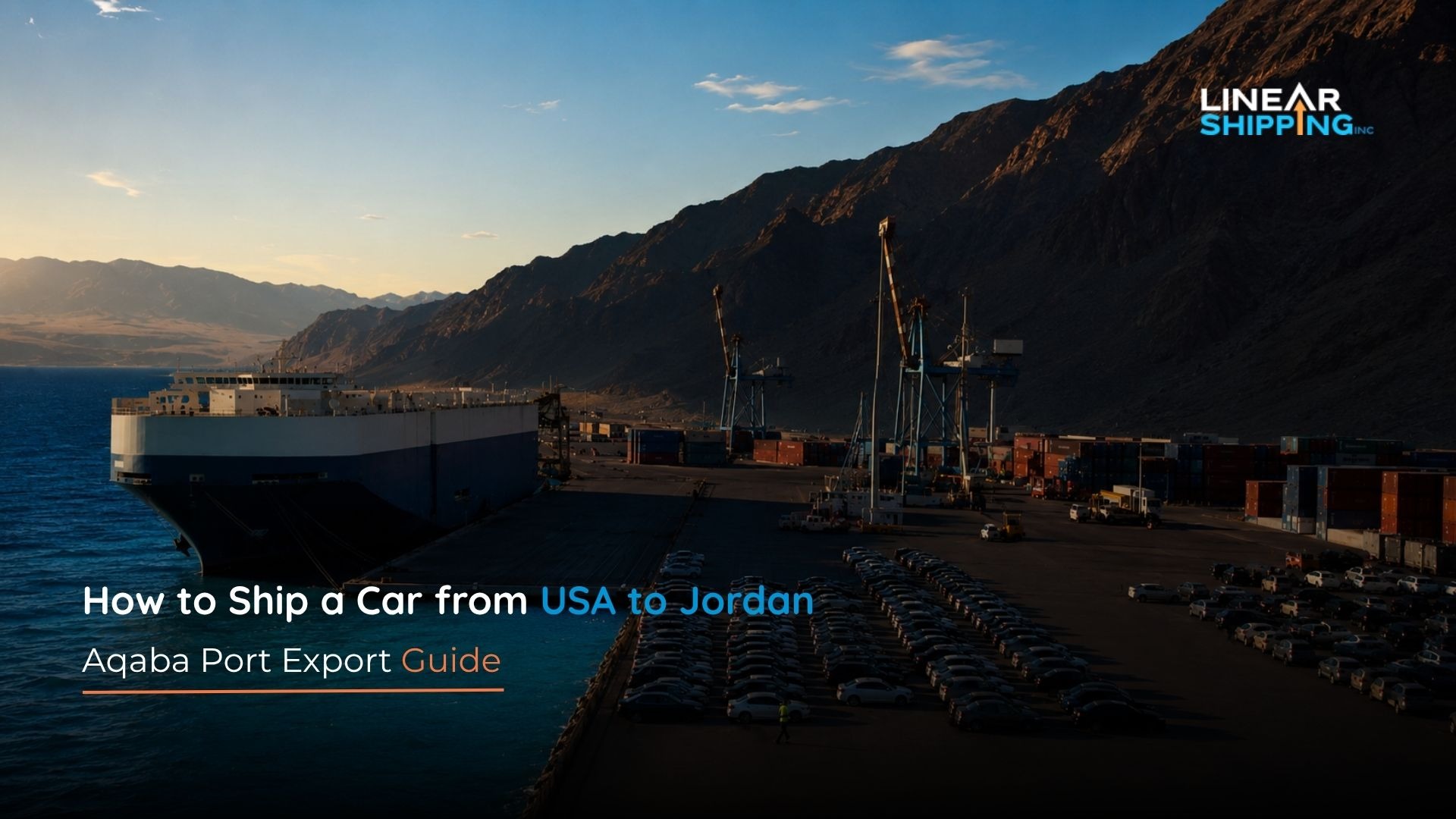
How do I ship a car from the USA to Jordan?
To ship a car from the USA to Jordan, book RoRo or container ocean freight from a US East Coast or Gulf port to Aqaba, Jordan's only seaport, and file Electronic Export Information through the Automated Export System first. Transit runs about 4 to 7 weeks. Jordan reformed its vehicle taxes in 2025, with total taxes of roughly 51 percent on gasoline cars, 39 percent on hybrids and a flat 27 percent on electric vehicles, assessed on a government-set value. Aqaba also serves as a re-export gateway into Iraq and the Levant.
Jordan is a compact but strategically important market on the USA to Middle East vehicle map, and it punches above its size for one reason: Aqaba is not only Jordan's own gateway, it is a re-export hub feeding Iraq and the wider Levant. American cars, SUVs and pickups move well into Jordan on their own merits, and a significant share of the vehicles that land at Aqaba are destined onward across the region, which is what makes this lane valuable to dealers well beyond Jordanian buyers alone.
This guide covers the USA to Aqaba lane end to end: the port and its special economic zone, the RoRo and container options available on this route, how Jordan's recently reformed vehicle taxes are calculated by engine size, fuel type and age, the re-export corridor into Iraq, transit times, the documentation and the clearance steps unique to Aqaba. It sits alongside the broader cars to the Middle East corridor as one of its most flexible entry points.
Aqaba, Jordan's sole seaport, and its regional role
Jordan has exactly one seaport, and that single fact shapes the whole lane. Aqaba sits at the country's southern tip on the Red Sea, on the Gulf of Aqaba, and every vehicle entering Jordan by sea comes through it. The port is managed by the Aqaba Development Corporation under the Aqaba Special Economic Zone Authority, and it runs general cargo terminals, a dedicated container terminal, a grain terminal and roll-on roll-off berths across its terminals, making it the second-largest port on the Red Sea.
Its role reaches well past Jordan's borders. Because Aqaba is the nearest deep-water access for a cluster of landlocked and conflict-affected neighbors, it functions as a regional gateway into Iraq, Saudi Arabia and Syria, with adjacent free zones and logistics facilities built for exactly that transit trade. For a car importer, Aqaba is both the destination for Jordanian-bound vehicles and a staging point for cars moving onward, and it connects inland by road to Amman, Zarqa, Irbid and the rest of the country.
The Aqaba Special Economic Zone and its import treatment
What sets Aqaba apart from most regional ports is that the entire zone around it is a special economic area. The Aqaba Special Economic Zone, administered by ASEZA, applies a lighter tax and customs regime than the rest of Jordan and offers duty-free storage and value-added logistics services inside its boundaries. Goods, including vehicles, can be received, stored and handled within the zone before a final decision is made on whether they clear into the Jordanian market or move onward.
This matters in two ways. For a vehicle destined for Jordan itself, the zone provides an orderly place for inspection and processing before the full national taxes are applied on entry to the domestic market. For a vehicle destined for onward movement, the zone and Jordan's associated free zones allow the car to be held and re-exported without being drawn fully into Jordanian taxation, which is the mechanism that makes Aqaba a workable re-export base. The treatment a specific vehicle receives depends on whether it is cleared for domestic use or handled as transit or free-zone cargo, so the intended end market should be fixed before the car arrives.
RoRo and container availability on the USA to Aqaba lane
Unlike some Middle East lanes where roll-on roll-off service is thin, Aqaba is genuinely equipped for both methods, which gives a shipper a real choice.
RoRo is well supported at Aqaba, which has the ramps and specialized berths to receive vehicle carriers, and it is the most economical option for a running, empty vehicle that can be driven aboard. For dealers moving operable cars and trucks in volume, RoRo is often the default. Container is the choice when protection matters, when the vehicle does not run, or when the shipper wants to consolidate two or more cars in a 40-foot box and declare spare parts alongside them, none of which RoRo allows. Because Aqaba handles container, RoRo, LoLo and flat rack, the method can be matched to the exact vehicle rather than dictated by the port, and the wider logic of international auto shipping applies cleanly here: running and standard favors RoRo, protected, non-running or consolidated favors container.
Jordanian customs duties by engine size, fuel type and vehicle age
Jordan is known for heavy vehicle taxation, but the structure was reformed in 2025, so older figures circulating online are misleading. Under the amended system, total taxes, which combine customs duty, the special tax and general sales tax, were cut substantially and now differ mainly by fuel type:
| Vehicle type | Approximate total tax |
|---|---|
| Gasoline cars | Around 51 percent |
| Hybrid cars | Around 39 percent |
| Electric vehicles | A flat 27 percent, unified across categories |
Two points decide what a specific car actually pays. First, the tax is applied to a government-assessed value, not the auction price, and that assessed value is set from the vehicle's year, make, model, engine capacity and optional equipment, which is where engine size feeds directly into the bill. A larger engine and a higher assessed value raise the amount owed even at the same headline rate. Second, pickups, vans and trucks sit on their own lower schedules than passenger cars, so the vehicle category matters as much as the fuel type.
Age and standards rules narrow the field further. Personal imports are generally limited to vehicles about 5 years old or newer, while commercial importers have more flexibility, and from late 2025 all imported cars must meet a recognized US, European, Gulf or Saudi technical standard. Electric vehicles carry an additional catch: those more than about three years old, counting the year of clearance, are no longer eligible. Left-hand-drive vehicles are standard and accepted, which suits US cars, but the current age, standards and tax figures should always be confirmed with a Jordanian customs broker before bidding, since this is an area Jordan actively adjusts.
The re-export corridor: Jordan into Iraq and the Levant
The feature that lifts this lane above a single-country market is re-export. Aqaba and Jordan's free zones function as a staging base for vehicles moving onward, and Iraqi car importers in particular operate out of the Jordanian free zones, bringing cars in through Aqaba and re-exporting them overland into Iraq. The same corridor feeds other Levant markets, using Jordan's road network and its position as the nearest stable coastline for the region.
For a dealer, this widens the addressable market considerably. A car that might not suit the Jordanian domestic market on age or tax grounds can still move through Aqaba as transit or free-zone cargo bound for a neighboring country, and the onward leg into Iraq connects to a lane with its own strong auction demand. The key is to declare the intended destination correctly from the outset, because a vehicle cleared into Jordan for domestic use follows a different path than one handled as re-export cargo, and the two cannot be swapped after the fact without cost and delay.
Transit time from US East Coast and Gulf ports
Transit from the United States to Aqaba typically runs about 4 to 7 weeks, depending on the departure port, the routing and whether the service sails via the Suez corridor or transships through a hub. The active US departure ports for this lane include the East Coast gateways of New York and New Jersey, Baltimore, Norfolk, Charleston, Savannah and Jacksonville, along with the Gulf ports of Houston and Galveston, so a vehicle can usually be routed through whichever port is closest to where it was bought.
As with any Middle East lane, vessel schedules and any transshipment connection move through the year, so the transit figure is a planning guide rather than a fixed promise. Preparing the documentation early, so the car is ready to clear the moment it lands, is what keeps a shipment from stalling at Aqaba, and it matters more than shaving a few days off the ocean leg. A comparable North African run into Libya transships through the Mediterranean and takes longer, which is a useful contrast when planning a mixed regional program.
Documentation and consignee requirements
Jordan clears vehicles through an electronic declaration that only an authorized local agent can file, so the document set has to be complete and consistent before the car arrives. A shipment generally needs the following.
- Original vehicle title, clear of liens, establishing ownership.
- Commercial or auction invoice and bill of sale, showing the VIN, make, model, year and value.
- Original bill of lading, naming the consignee exactly as Jordanian customs expects and matching the export filing.
- AES filing and ITN, the US export declaration and its confirmation number, completed before the vessel sails.
- Pre-shipment inspection certificate, since Jordan requires an origin-country inspection for used vehicles.
- Consignee identification, a recognized Jordanian importer or an authorized free-zone entity for re-export cargo.
Because the exporter remains responsible for the accuracy of the US export data even when a forwarder submits it, getting the AES filing right is part of keeping the whole chain clean, and working through the same discipline captured in a proper checklist for exporting used cars to the Middle East is what prevents the document mismatches that cause holds at Aqaba.
Common clearance considerations at Aqaba
Aqaba runs a strict, structured clearance process, and knowing its steps prevents surprises.
- Pre-shipment and arrival inspection. Jordan requires an inspection in the country of origin, and vehicles are also inspected on arrival by a recognized body such as Bureau Veritas, so a car has to be presented clean and as declared.
- Free-zone testing and eligibility. Used vehicles are moved to a free-zone facility to be tested against Jordanian motor vehicle specifications, and they must pass before they can be registered and released.
- Assessed-value duties. Duties and taxes are calculated on the customs department's assessed value rather than the invoice, so the landed tax should be estimated on the specific vehicle in advance.
- Consignee and destination accuracy. Whether the car is cleared for Jordan or handled as re-export cargo must be fixed before arrival, since the paths diverge and cannot be swapped cheaply later.
Nearly every delay at Aqaba traces back to a documentation, valuation or eligibility issue rather than the shipping itself, which is exactly the part a capable forwarder controls. Mapping the port, the taxes, the eligibility and the intended market for a specific vehicle before booking is what keeps the lane predictable, and you can start that conversation about your shipment once you have the car, the destination and the consignee details in hand.
Frequently asked questions
Can I ship a car from the USA to Jordan?
Yes. American cars, SUVs and pickups ship regularly from US East Coast and Gulf ports to Aqaba, Jordan's only seaport, by RoRo or container. The vehicle must meet Jordan's age and standards rules, usually about 5 years or newer for personal imports, the consignee must be a recognized Jordanian importer or authorized free-zone entity, and the US export must be filed through the Automated Export System before shipping.
What are Jordan's import duties on used vehicles?
Jordan reformed its vehicle taxes in 2025. Total taxes, combining customs duty, special tax and sales tax, now run at roughly 51 percent for gasoline cars, 39 percent for hybrids and a flat 27 percent for electric vehicles, with pickups and trucks on lower schedules. The tax is applied to a government-assessed value based on the vehicle's year, make, model and engine capacity, not the auction price, so the exact amount should be confirmed with a Jordanian customs broker for the specific car.
How long does shipping take from the USA to Aqaba?
Transit from US ports to Aqaba typically runs about 4 to 7 weeks, depending on the departure port, the routing and whether the service sails via the Suez corridor or transships through a hub. Vessel schedules shift through the year, so the figure is a planning guide, and preparing documentation early is the best way to keep the car moving once it lands.
Can vehicles imported into Jordan be re-exported to Iraq?
Yes. Aqaba and Jordan's free zones function as a re-export corridor, and Iraqi importers commonly bring vehicles in through Aqaba and move them overland into Iraq. To do this, the car is handled as transit or free-zone cargo rather than cleared into the Jordanian domestic market, so the intended destination must be declared correctly from the start, since the two paths follow different customs treatment.