How Does Ocean Freight Consolidation Work? LCL, FAK, and CFS Explained
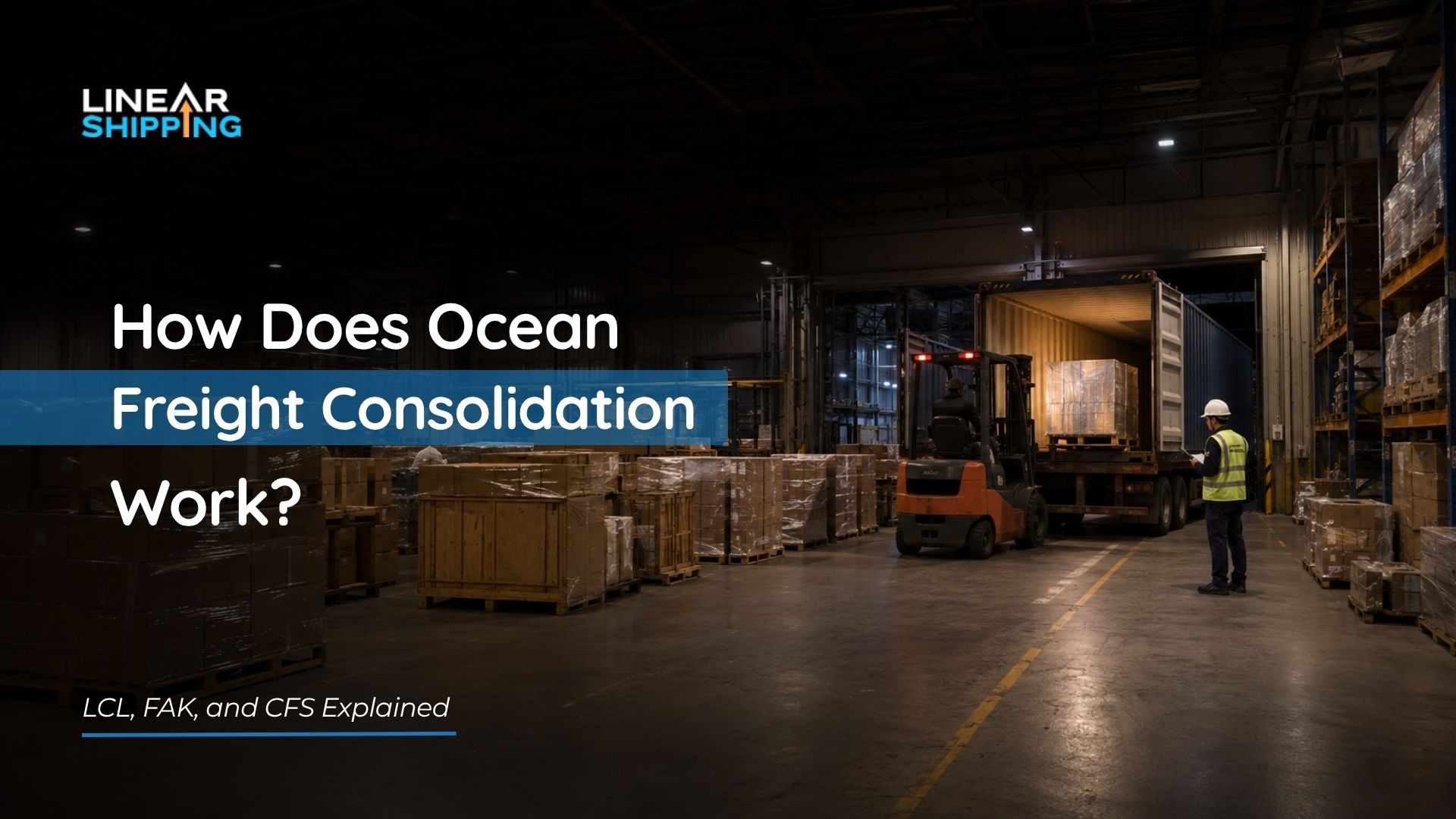
How does ocean freight consolidation work?
Ocean freight consolidation combines cargo from several shippers into one shared container at a Container Freight Station. Each shipper pays only for the space their goods occupy, measured in cubic meters. The consolidator stuffs the container, sails it under one Master Bill of Lading, and issues each shipper a House Bill of Lading. At destination, the container is deconsolidated and each consignment is released to its own consignee.
Most shippers reach a point where they understand they need consolidation but have no clear picture of how it actually works. They know their cargo does not fill a container, they know sharing space is cheaper, and they have heard the terms LCL, FAK and CFS, but the end-to-end mechanics stay fuzzy. This guide fixes that. It walks the entire process from the moment cargo leaves a shipper to the moment it is released to a consignee overseas, and it explains the roles, documents and decisions that make a shared container work.
Consolidation is one of the foundational mechanics of ocean freight, and once you can picture the flow, the rest of the language, the bills of lading, the rate structures, the cutoffs, falls into place. What follows is the operational explainer, not a sales pitch.
What consolidation means in ocean freight
Consolidation has two sides, one physical and one commercial, and understanding both makes the rest of the process clear.
Physically, consolidation is the act of combining cargo from multiple shippers into a single container. A shipping container is sold and moved as one sealed unit, so rather than send a half-empty box, a consolidator gathers several partial loads that are all heading in the same direction and packs them together until the container is full. That packing operation is what makes the economics work, because a container that would otherwise sail with wasted space now carries paying cargo in every cubic meter.
Commercially, consolidation is a pricing model. Instead of paying for a whole container, each shipper pays only for the space their goods occupy, measured in cubic meters or, for dense cargo, by weight. This is what a less than container load, or LCL, shipment is: a share of a container billed by the room it takes. The consolidator buys the full container from the ocean carrier at a bulk rate and resells the space in slices, which is how small and mid-size shippers reach ocean markets without the cost of a dedicated box.
The Container Freight Station: where cargo enters and exits
The physical work of consolidation happens at a Container Freight Station (CFS), a warehouse facility located near the port. Think of it as the backstage of ocean freight, where many small shipments are organized into full container loads for export and broken back down into individual consignments after import. It is distinct from the Container Yard, or CY, where whole sealed containers are stored and staged for the vessel.
At origin, the CFS receives each shipper's cargo by truck, inspects and measures it, records the actual cubic meters and weight, and holds it until enough compatible cargo is gathered to build a container. Trained staff then load, or stuff, the container to a stowage plan that balances weight, protects fragile items and minimizes dead space, after which it is sealed and the seal number is recorded. At destination, the mirror image happens: the container is opened, or stripped, the goods are checked against the bills and packing lists, and each consignment is sorted to its own consignee lot for customs clearance and release.
How cargo is segregated by destination
A single consolidated container travels to one deconsolidation point, so cargo has to be grouped by destination before it is stuffed. The CFS gathers LCL shipments that share a destination port and builds the container from that pool, which keeps the box moving to a single stripping location where every consignment inside can be released. This is why a consolidation service quotes specific port pairs rather than promising to combine any cargo with any other, and why matching your shipment to an existing consolidation lane keeps it moving on a regular schedule.
How a consolidator or NVOCC manages a shared container
The party that orchestrates all of this is the consolidator, often a non-vessel operating common carrier, or NVOCC. An NVOCC does not own ships. Instead, it buys container space from the actual ocean carrier in volume, then acts as a carrier in its own right to many smaller shippers, taking responsibility for their cargo and issuing its own transport documents.
This role is what makes a shared container possible. The NVOCC commits to the carrier for the whole box, aggregates enough individual shipments to fill it, manages the stuffing at the CFS, and handles the paperwork that keeps each shipper's cargo legally and physically distinct inside a container they are all sharing. Because the NVOCC carries the relationship with the ocean line, individual shippers deal with the consolidator rather than negotiating directly with the vessel operator, which simplifies the whole arrangement for a business moving modest volumes.
The LCL booking process, step by step
For a shipper, an LCL consolidation runs through a predictable sequence. Each step has a cutoff, and missing one usually pushes the cargo to the next sailing.
- Booking. The shipper confirms the volume, weight, commodity and the consolidation cutoff with the forwarder or consolidator, who reserves space on a container heading to the destination.
- Cargo delivery to the origin CFS. The goods are delivered to the CFS a few days before the cutoff, with the commercial invoice, packing list and HS codes attached.
- Receipt and measurement. The CFS receives, inspects and measures the cargo, recording the actual cubic meters and weight that the billing is based on, and a draft House Bill of Lading is prepared.
- Stowage planning and stuffing. Once enough compatible cargo is gathered, the consolidator plans the load and stuffs the container, securing and separating each consignment, then seals it.
- Export formalities. The container moves to the yard, export customs is handled, and in the United States the Automated Export System filing is completed at this stage.
- Ocean transit. The container sails on the same vessel it would as a full load, so the sea time itself is no longer than FCL on the same lane.
- Deconsolidation and release. At the destination CFS the container is stripped, cargo is sorted by consignee, cleared through customs, and released for pickup or final delivery.
The consolidation and deconsolidation steps are why LCL adds a little time overall, typically in the range of three to seven days across both ends compared with a full container, since the ocean leg is identical but the CFS handling at origin and destination is extra.
FAK rates inside a consolidated container
A consolidated container usually holds a mix of different commodities from different shippers, which raises a pricing question: how do you rate a box full of unrelated goods? The answer is the freight all kinds, or FAK, structure. Rather than assign each commodity its own class-based rate, the consolidator applies a single blended rate across the container, which simplifies pricing and keeps the shared box commercially workable.
This is where the two ideas connect. LCL describes how the space is sold, by the cubic meter, while FAK describes how the mixed cargo is rated, under one blended tariff. Seeing exactly how LCL and FAK differ makes it clear that they are complementary rather than competing, and understanding what counts as a FAK commodity in the first place explains why a consolidator can group varied goods under one rate without classifying each item separately. For a shipper, the practical effect is a simpler, more predictable number on a container that may hold a dozen different products.
House Bill of Lading vs Master Bill of Lading
Consolidation produces two layers of bills of lading, and confusing them is one of the most common sources of error in LCL shipping.
The Master Bill of Lading (MBL) is issued by the actual ocean carrier to the consolidator or NVOCC. It covers the entire container as a single unit and names the NVOCC as the shipper on the carrier's records. There is one MBL for the whole box, regardless of how many individual shipments are inside.
The House Bill of Lading (HBL) is issued by the consolidator to each individual shipper. It names that shipper and their consignee, describes only that shipper's portion of the cargo, and references the underlying MBL. Every shipment in the container has its own HBL, so a single consolidated box might sail under one MBL and a dozen HBLs. For an individual shipper, the HBL is the operative document, and it is the one presented to the bank in a letter of credit transaction rather than the MBL.
The documentation flow from shipper to carrier
The paperwork moves in a clear chain. Each shipper hands the consolidator a commercial invoice, packing list and HS codes with the cargo. The consolidator uses those to prepare each shipper's House Bill and to build the container manifest, then presents the consolidated cargo to the ocean carrier, which issues the single Master Bill covering the whole box. In effect, many sets of shipper documents feed up into one carrier document, and the consolidator sits in the middle translating between the two layers. Keeping the descriptions, weights and values consistent from the invoice through to the House Bill is what keeps the whole chain clean and prevents a hold at either end.
How Linear Shipping's warehouse consolidation works
Running consolidation well is a warehouse discipline as much as a shipping one. Cargo is received and staged at the consolidation facility, measured and recorded so billing reflects the true cubic meters, and held until a container to the destination is ready to build. The stuffing is planned to protect and separate each consignment, the export filing and House Bills are prepared in parallel, and the sealed container is moved to the terminal in time for the vessel cutoff. Coordinated warehouse consolidation in Houston keeps the receiving, measuring, stuffing and documentation under one roof, which is where reliability on this kind of shipment comes from.
Because the physical handling and the paperwork are managed together, a shipper gets a single point of accountability for the whole flow. Pairing structured FAK consolidation with dependable ocean freight booking means the cargo, the rate and the documents all move as one process, which is exactly what turns an intimidating set of terms into a routine shipment.
Frequently asked questions
How does ocean freight consolidation work?
Ocean freight consolidation combines cargo from several shippers into one shared container at a Container Freight Station. Each shipper pays only for the space their goods occupy, measured in cubic meters. The consolidator stuffs the container, sails it under one Master Bill of Lading, and issues each shipper a House Bill of Lading. At destination, the container is deconsolidated and each consignment is released to its own consignee.
What is a CFS in shipping?
A CFS, or Container Freight Station, is a warehouse facility near the port where less than container load cargo from multiple shippers is received, measured and stuffed into a shared container at origin, and deconsolidated at destination. It is distinct from the Container Yard, where whole sealed containers are stored, and it is where the physical work of consolidation actually takes place.
What is the difference between a House Bill and a Master Bill of Lading?
The Master Bill of Lading is issued by the ocean carrier to the consolidator and covers the entire container as one unit. The House Bill of Lading is issued by the consolidator to each individual shipper, names that shipper and consignee, and references the Master Bill. A consolidated container has one Master Bill and a separate House Bill for each shipment inside it.
How long does LCL consolidation take?
LCL typically adds about three to seven days to the total transit compared with a full container on the same lane. This comes from CFS processing, roughly one to three days at origin for consolidation and two to four days at destination for deconsolidation, while the ocean transit itself is the same because the container sails on the same vessel as a full load.
Can cargo from different companies share the same container?
Yes. That is the core of consolidation. A consolidator combines cargo from multiple unrelated companies into one shared container, keeping each shipment physically separated and documented under its own House Bill of Lading. Every shipper pays only for the space they use, and each consignment is released to its own consignee after the container is deconsolidated at destination.